Sambhaji Maharaj Escapes Sangameshwar: The War Continues
When Sambhaji Maharaj ascended the Maratha throne in 1681 after the death of his father Shivaji Maharaj, he inherited far more than a crown. Over three decades, Shivaji had transformed Swarajya from a collection of scattered hill forts into the most powerful and dynamic kingdom in western India. Through relentless campaigns against the Adilshahi Sultanate, the Mughal Empire, and numerous regional chiefs, he had built a state stretching across much of Maharashtra, the Konkan coast, and parts of Karnataka. Yet the kingdom remained young, surrounded by powerful enemies and sustained through constant vigilance rather than lasting peace. Having grown up amidst military campaigns, diplomacy, and power politics, Sambhaji now carried the responsibility of protecting not only his father's territorial achievements but also the very ideal of Swarajya that Shivaji had established through years of sacrifice and struggle.
The challenges before the new ruler were immense. The Portuguese continued to defend their coastal possessions, while the weakening Deccan Sultanates struggled to preserve what remained of their authority. Above all stood the Mughal emperor Aurangzeb, whose empire possessed unmatched wealth, vast armies, and enormous resources. Determined to bring the independent Maratha kingdom under Mughal rule, Aurangzeb prepared for a long and relentless campaign that would draw the entire Deccan into war. It was under these difficult circumstances of mounting pressure and constant conflict that Sambhaji Maharaj inherited Shivaji's legacy, leading a kingdom built through extraordinary courage and sacrifice and destined to face its greatest challenge.
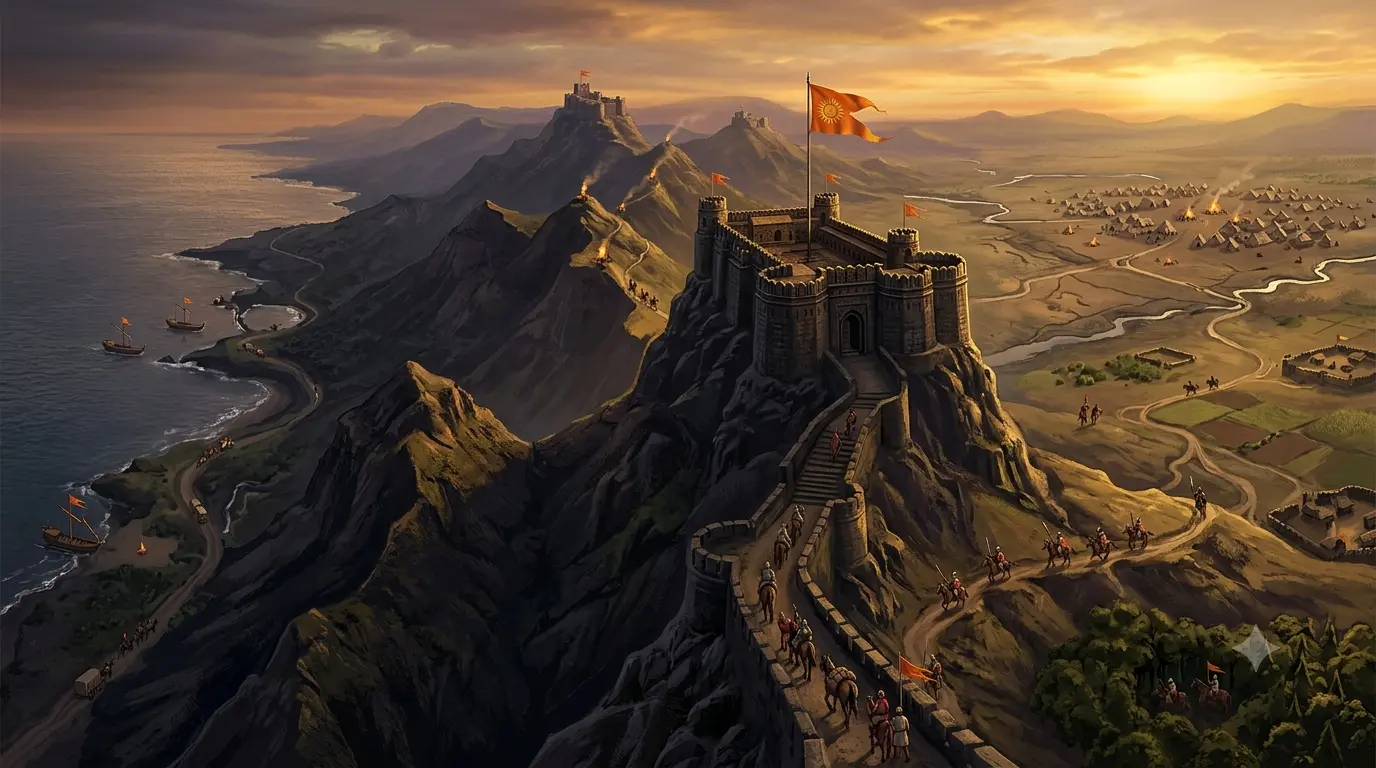
Unlike the Mughal Empire, the Maratha state did not possess vast revenues or great imperial cities. Its strength rested on mobility, local support, and the natural defenses of the land. The Konkan coast provided ports, naval bases, customs revenue, and access to Arabian Sea trade, while the Sahyadri forts protected the kingdom. The Deccan plateau supplied skilled cavalry and infantry familiar with the rugged terrain. Villagers, patils, deshmukhs, and hereditary warrior families formed a dependable network that carried messages, food, horses, and intelligence across the countryside. Even when Mughal forces occupied towns, they often remained surrounded by hostile territory. Forests, ravines, and mountain passes made supply lines vulnerable, allowing Maratha cavalry to strike quickly and disappear before a larger army could react. Under Sambhaji Maharaj, this flexible style of warfare became even more pronounced. His court frequently changed location, garrisons were constantly reinforced or shifted, and Maratha sardars carried out independent raids deep inside enemy territory, ensuring that the kingdom remained active and difficult to subdue.
Before 1689, despite relentless Mughal invasions, Sambhaji continued to control the core Maratha homeland. Raigad remained the political and symbolic capital of Swarajya, while much of the Sahyadri region, including its vital hill forts linking the Deccan plateau with the Konkan coast, stayed under Maratha authority. Their influence also remained strong around Satara, Wai, and nearby mountain regions, while the contested Konkan continued to provide valuable routes for movement and refuge. In the south, Maratha positions established during Shivaji Maharaj's campaigns survived in parts of Karnataka, giving the kingdom valuable strategic depth. However, the boundaries of Swarajya were constantly changing. Forts and territories frequently passed between Mughal and Maratha control, some regions paid tribute to both sides, and repeated warfare devastated many districts.
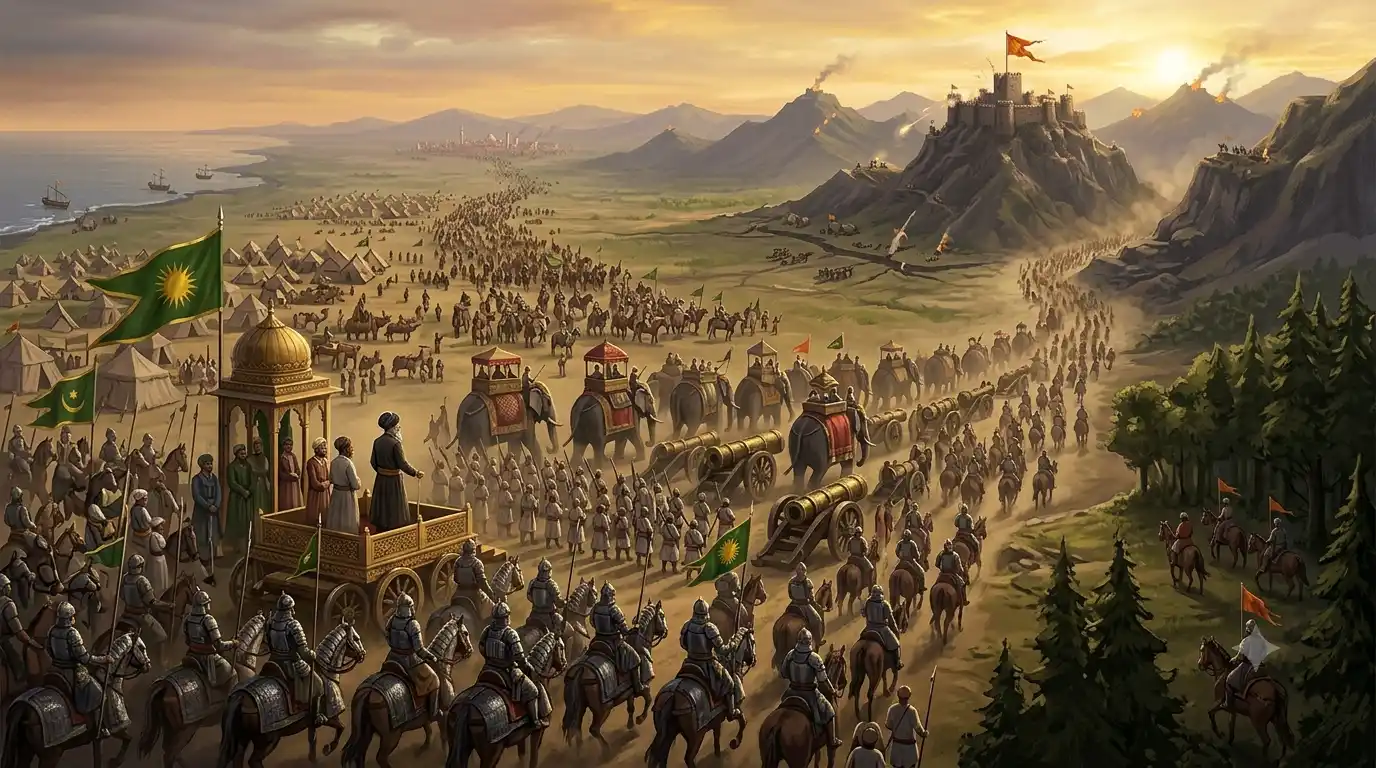
Before Emperor Aurangzeb began his Deccan campaign, the Mughal Empire was at the height of its power. Stretching from Kabul to Bengal, it controlled most of northern India and drew immense revenue from fertile farmlands, thriving trade centers, and prosperous ports. Cities such as Delhi, Agra, Lahore, and Ahmedabad were renowned for their wealth, while well-maintained imperial roads carried caravans protected by Mughal garrisons. The emperor commanded one of the largest armies in the world, supported by vast numbers of cavalry, artillery, war elephants, engineers, and provincial forces led by influential nobles. Aurangzeb himself had ruled for decades and was respected as a disciplined, determined, and capable ruler. Unlike many earlier Mughal emperors known for luxury and courtly grandeur, he lived simply and devoted himself to imperial administration, military expansion, and the enforcement of his policies. By the early 1680s, most of northern India was firmly under Mughal authority, with the Rajputs weakened, Bengal prosperous and loyal, and the Afghan frontier relatively under control.
Despite its immense power, one major region remained beyond complete Mughal control—the Deccan. For many years, the southern plateau had resisted imperial expansion. The Sultanates of Bijapur and Golconda still survived, while the Marathas under Shivaji Maharaj had grown from a regional force into a powerful kingdom capable of challenging Mughal authority. Aurangzeb believed that the empire could never be truly united while the Deccan remained independent. Determined to end this long-standing challenge, he took a decision that no previous Mughal emperor had attempted. He personally led the imperial campaign into the Deccan with the full strength of the Mughal Empire, resolved to remain there until every southern rival had been brought under Mughal rule.
When Aurangzeb entered the Deccan in 1681, he came not as a temporary conqueror but as an emperor determined to end a conflict that had challenged the Mughal throne for decades. His southward march resembled a moving capital, with armies, artillery, nobles, merchants, clerics, and long supply caravans accompanying him. His initial strategy was to defeat the Deccan Sultanates before turning the full strength of the Mughal Empire against the Marathas. With its larger armies, immense wealth, powerful artillery, and experienced commanders, the empire appeared to hold every advantage. Bijapur resisted fiercely but eventually fell in 1686 after a prolonged siege, and Golconda followed in 1687, bringing its famous fort, immense wealth, and treasury under Mughal control. Many believed that the conquest of the Deccan was nearly complete. Instead, the fall of these Sultanates transformed the war, leaving the Marathas under Sambhaji Maharaj as Aurangzeb's sole major opponent.
Expecting a swift victory, Aurangzeb soon discovered that the Marathas would not fight like a conventional kingdom. Rather than facing the Mughals in open battle, they relied on rapid cavalry raids, attacks on supply lines, ambushes in mountain passes, and strong resistance from hill forts. The Sahyadri mountains, harsh monsoons, difficult terrain, disease, and disrupted supply routes constantly weakened Mughal operations, while territory captured during one season was often lost in the next. Sambhaji continued launching raids into Mughal territory and also campaigned against the Portuguese and Siddis along the Konkan coast to strengthen Maratha security. In response, Aurangzeb adopted harsher measures, destroying crops, targeting villages suspected of aiding the Marathas, and pressuring local chiefs to submit. Yet the conflict dragged on as Maratha forces repeatedly reappeared after every setback. By 1688, Aurangzeb shifted his focus from capturing territory to capturing Sambhaji himself. Mughal spies spread across the Konkan and western hills, intelligence networks expanded, local rivalries were exploited, and secret correspondence was intercepted. The emperor had concluded that as long as Sambhaji remained free, the war could never truly be won. During the winter of 1688–1689, news reached the Mughal camp that the Maratha king had moved toward Sangameshwar in the Konkan.
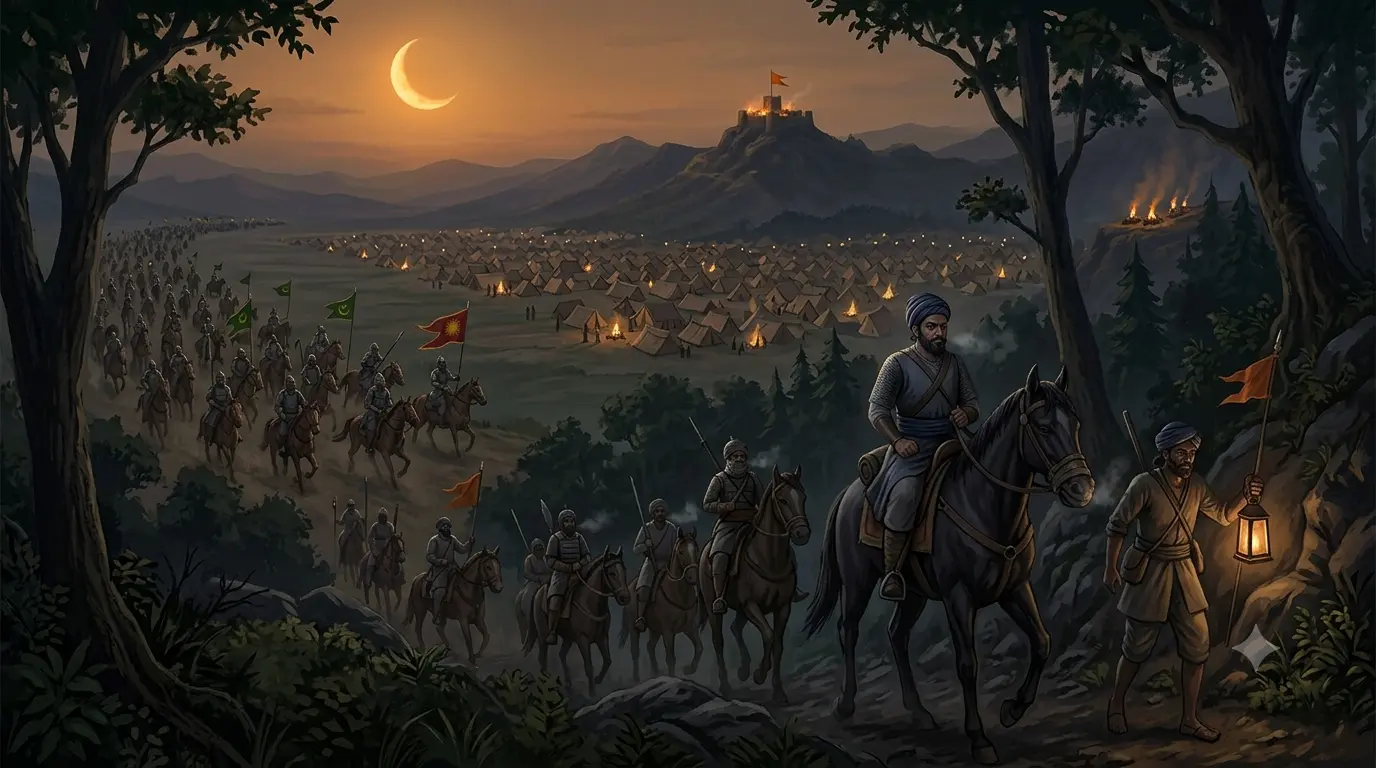
The Mughal trap at Sangameshwar was carefully planned. For two days, Mukarrab Khan marched his forces through the dense forests of the Konkan without drums, banners, or campfires, relying on local informers to track Sambhaji Maharaj's movements. Once he learned that the Maratha king was staying near Sangameshwar with only a small escort, he acted before dawn. Cavalry sealed the main roads, matchlockmen occupied the surrounding hills, and smaller detachments guarded river crossings and forest paths, creating what appeared to be a complete encirclement. The first sign of danger came when a wounded Maratha scout reached the camp and, with his last strength, warned that Mughal forces were approaching from every direction. While some commanders called for an immediate attack and others urged a retreat into the hills, Sambhaji remained calm. Realizing that the Mughals expected him to escape along the main routes, he chose to mislead them instead. A large Maratha detachment carrying the royal standards rode noisily toward the northern road before sunrise, with several soldiers dressed as the king's personal guards to convince the enemy that Sambhaji was among them. Believing he had found his target, Mukarrab Khan sent hundreds of cavalry in pursuit.
Mukarrab Khan returned to Aurangzeb's camp in disgrace after failing to capture Sambhaji Maharaj. Despite surrounding Sangameshwar from every direction with a carefully planned operation, the Maratha ruler had escaped before the Mughal forces could close the trap. Summoned before the imperial court, Mukarrab Khan faced Aurangzeb's anger in the presence of his nobles. The emperor sharply rebuked him, saying, "You took the army of the Mughal Empire to catch one Maratha king... and still failed." His words silenced the entire court, and no noble dared to speak in Mukarrab Khan's defense. The failed mission became a major embarrassment for the Mughal command, especially after so much effort had been devoted to tracking Sambhaji's movements.
The people most shaken by the failure, however, were the informers who had revealed Sambhaji's location to the Mughals. Expecting rewards after his capture, they instead found themselves terrified of Maratha retaliation. Fearing that Sambhaji would discover their identities, some pleaded with Aurangzeb to send them safely to Agra. The emperor rejected their request without hesitation, reminding them that they had chosen to serve the Mughal Empire and would continue to do so in the Deccan. Aurangzeb also placed little trust in such men, believing that those who had betrayed their own ruler could one day betray him as well. As a result, the informers remained in the Mughal camp under close watch, living in constant fear while rumors of their betrayal gradually spread across Maharashtra.
After Sambhaji Maharaj escaped from Sangameshwar, Emperor Aurangzeb moved quickly to strengthen Mughal control over western Maharashtra. His objective was to restrict Maratha movement between the eastern Deccan plateau and the hill regions around Pune. To carry out this campaign, he appointed Zulfiqar Khan, one of his most capable commanders in the Deccan. Leading an army of nearly 70,000 men, including cavalry, infantry, artillery, elephants, supply carts, and thousands of camp followers, Zulfiqar Khan marched westward from the imperial camp near Ahmednagar. Passing through Supa, the Mughal force entered the Baramati region in overwhelming strength. The small Maratha garrison stationed there realized it could not resist such a large army in open battle and withdrew toward the hills before the Mughals completed their advance. Acting on Aurangzeb's orders, Zulfiqar Khan devastated the region to deny resources to the Marathas. Crops were burned, grain stores seized, wells damaged, and villages suspected of supporting Swarajya were looted in search of food, horses, and supplies. For days, smoke covered the countryside as the Mughals hoped that fear and destruction would weaken resistance around Pune before launching larger operations.
News of the devastation at Baramati quickly reached Sambhaji Maharaj. Reports described fleeing villagers, burning fields, and Mughal scouts moving steadily toward the Pune region. Sambhaji immediately recognized the strategic danger. If Zulfiqar Khan established a strong Mughal base in Pune, it would threaten the routes leading to the Maratha hill forts and weaken control over western Maharashtra. Determined to act before the enemy could consolidate its position, Sambhaji entrusted the mission to Santaji Ghorpade, the Marathas' most feared cavalry commander. Renowned for his speed, bold tactics, and unpredictable attacks, Santaji had already earned a formidable reputation by striking Mughal camps and supply lines with little warning. Among Mughal soldiers, it was often said that Santaji's horsemen appeared like ghosts, attacked with devastating force, and disappeared before the enemy could organize an effective response.
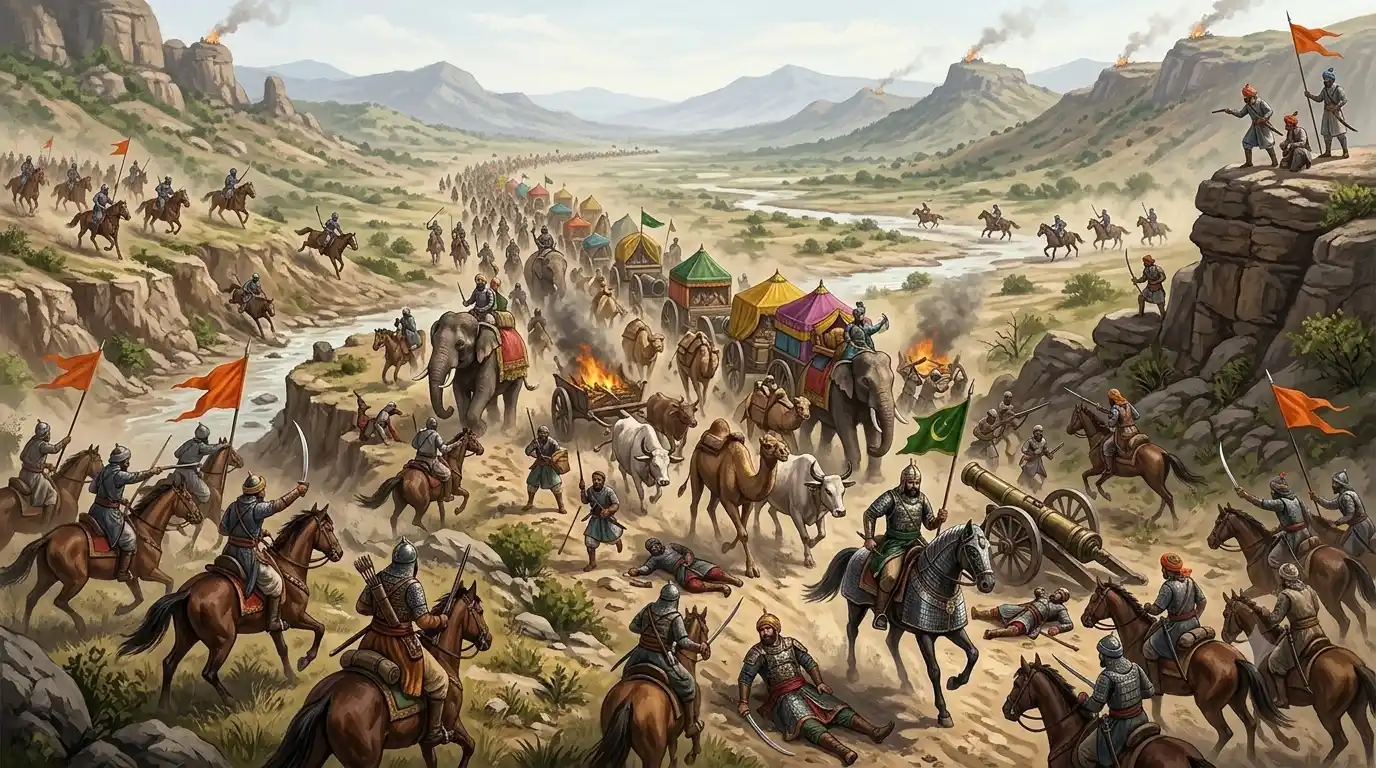
As Zulfiqar Khan’s massive Mughal army marched from Baramati toward Jejuri, confidence grew within the imperial camp. The Marathas had withdrawn with little resistance, leading many officers to believe Sambhaji was too weakened after Sangameshwar to launch a major attack. Santaji Ghorpade, however, had been tracking the Mughal advance from the surrounding hills. With only eight to ten thousand cavalrymen, he knew an open battle against seventy thousand troops was impossible. Instead, he relied on speed, terrain, and surprise. Before dawn, Maratha scouts blocked smaller routes while hidden cavalry occupied positions behind hills and dry riverbeds. Santaji waited until the Mughal army stretched out during its march, leaving its supply train, artillery, and slower infantry vulnerable.
The Marathas struck the Mughal baggage train first, charging from the hills with war cries while firing arrows and matchlocks into the supply columns. Bullocks panicked, elephants lost formation, and grain carts caught fire before the attackers disappeared into the rough terrain. Believing it was only a small raid, Zulfiqar Khan delayed his response. Soon another Maratha force attacked the rear guard, raising clouds of dust to make its numbers appear larger. Confusion spread rapidly as officers struggled to identify the threat. Some believed the entire Maratha army had arrived, while others feared Sambhaji himself was nearby, causing conflicting orders and disorganized movements.
Before noon, Santaji launched another assault, targeting artillery crews and horse lines. The repeated attacks from different directions prevented the Mughal cannons from being deployed effectively, and several imperial officers were killed while trying to restore order. Fighting continued throughout the day in scattered engagements rather than a single pitched battle. Whenever Mughal cavalry attempted pursuit, the Marathas withdrew into difficult terrain before attacking elsewhere. By evening, Zulfiqar Khan secured the road toward Pune, but the Mughals had suffered heavy losses in supplies, animals, and manpower. Although Santaji did not completely halt the Mughal advance, his tactics dealt a major blow to imperial morale and proved that even the largest Mughal army could be weakened before reaching Pune.
After the fighting near Jejuri, Zulfiqar Khan’s advance slowed considerably. Santaji Ghorpade’s repeated attacks had not destroyed the Mughal army, but they turned its march into a constant struggle. The road from Baramati to Jejuri was littered with dead animals, broken carts, burned grain sacks, and abandoned equipment. Mughal soldiers slept little, as every hill, patch of trees, and narrow road seemed to hide danger. Maratha horsemen continued appearing without warning, striking supply lines, killing isolated scouts, or firing into camps after sunset before disappearing into the darkness.
The constant threat drained the imperial army more than open battle. By the time Zulfiqar Khan reached the Jejuri region, his soldiers were exhausted, hungry, and frustrated. Many horses had collapsed from overwork, supply reserves had fallen sharply, and officers struggled to maintain discipline among troops expecting attacks from every direction. Although the Mughal army remained large and powerful, the confidence it had carried from Ahmednagar had disappeared. Meanwhile, Santaji Ghorpade remained hidden in the surrounding hills, watching and waiting for another opportunity to strike.
After weeks of marching through hostile territory, Zulfiqar Khan finally entered Pune. What had begun as a confident advance from Ahmednagar had turned into a difficult campaign. Santaji Ghorpade’s cavalry had shadowed the Mughal army throughout the march, attacking supply columns, burning grain carts, killing scouts, and keeping soldiers under constant pressure. Horses were exhausted, food supplies had reduced, and the troops had little opportunity to rest. Believing his objective had been achieved, Zulfiqar Khan expected to regroup in Pune before continuing operations. Unknown to him, Sambhaji Maharaj had been preparing for this moment by gathering a large Maratha force around Pune, waiting until the Mughal army became tired, scattered, and vulnerable before launching a decisive attack.
Soon after the Mughals entered the city, their soldiers focused on setting up camps, unloading supplies, treating the wounded, and organizing their positions. Maratha scouts reported that the imperial army was spread out and unprepared. Sambhaji immediately ordered the advance, and thousands of Maratha horsemen moved toward Pune from multiple directions. At dawn, Maratha cavalry charged the Mughal positions before proper battle lines could be formed, while Santaji Ghorpade struck the rear of the camp. Confusion spread rapidly as Mughal officers struggled to organize their men. Some units attempted to form defensive lines, while others withdrew in panic, believing they had been surrounded. Dust clouds covered the battlefield as fierce cavalry fighting erupted across the plains outside Pune.
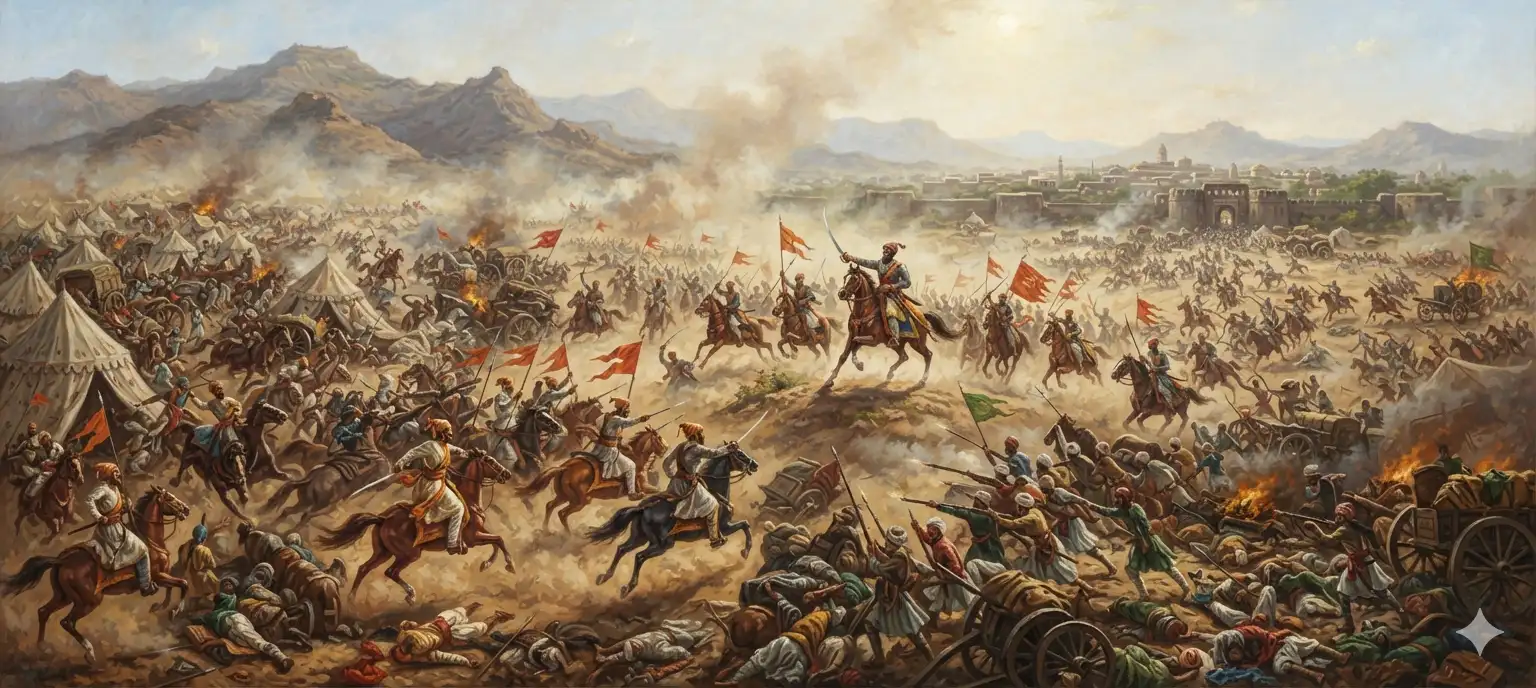 Sambhaji personally directed the battle, reinforcing sectors where Mughal resistance remained strong. The exhausted imperial soldiers fought bravely, but their worn-out horses, damaged supply system, and failing communication weakened their defense. Every effort to restore order was met by fresh Maratha cavalry attacks, giving Sambhaji complete control of the battlefield by midday. As the fighting intensified, panic spread through the Mughal camp. Supply wagons were captured, artillery positions overrun, and several senior officers were killed while rallying their troops. Thousands of soldiers abandoned their formations, while others were surrounded by fast-moving Maratha cavalry. Recognizing the battle was lost, Zulfiqar Khan escaped with a small body of guards, leaving behind much of his artillery, baggage, and supplies. As evening fell, the battlefield belonged to Sambhaji Maharaj. The Mughal army that had marched confidently from Ahmednagar was shattered outside Pune, and the victory spread across Maharashtra, restoring Maratha confidence and proving that Swarajya remained strong despite Aurangzeb’s campaign.
The defeat at Pune shocked the Mughal camp. Zulfiqar Khan barely escaped with his life, and his whereabouts remained unknown for several days until Mughal cavalry patrols located him east of Pune and safely escorted him back to Ahmednagar. Although furious, Aurangzeb refused to retreat. Instead, he adopted a new strategy by shifting his main field camp westward to Supa while leaving strong garrisons in Ahmednagar. From Supa, he planned a direct march on Raigad, believing Sambhaji Maharaj and the main Maratha army were still occupied around Pune. Capturing the Maratha capital quickly, he hoped, would deal a decisive blow to Swarajya before Sambhaji could respond.
Sambhaji, however, remained active after his victory at Pune. Joining forces with Santaji Ghorpade, he began restoring Maratha control over the surrounding region. Their first objective was Jejuri, where a Mughal column left behind by Zulfiqar Khan was holding the town. Expecting no major attack and assuming the Marathas were still celebrating, the Mughal garrison had relaxed its defenses. Sambhaji and Santaji seized the opportunity, launching coordinated cavalry attacks from multiple directions that overwhelmed the surprised defenders before they could organize an effective resistance.
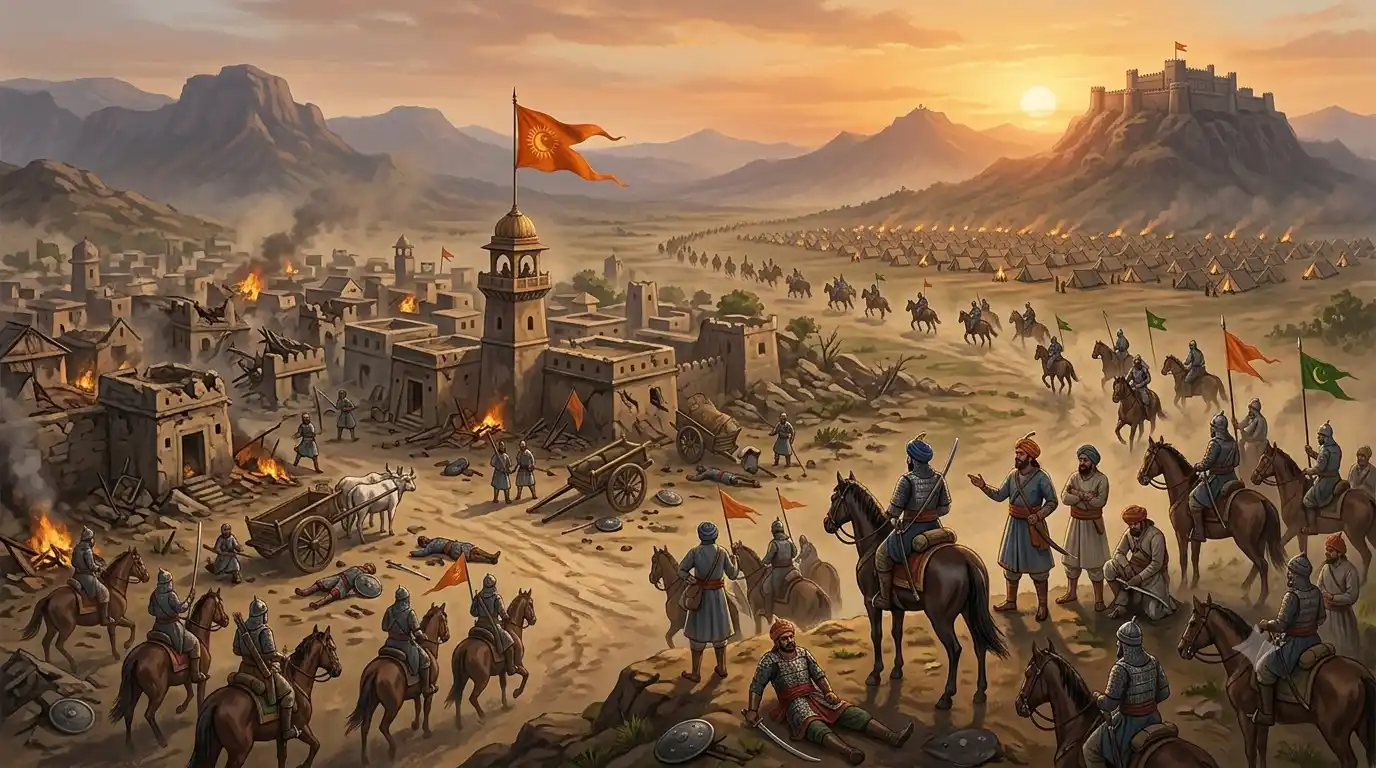
The fighting at Jejuri was brief but intense. Many Mughal soldiers were killed, while others fled toward Supa carrying news of the defeat. By sunset, Jejuri was once again under Maratha control, and the saffron banner of Swarajya flew over the town. The victory further strengthened Maratha morale and restored their dominance over the route between Pune and the eastern plains. However, the celebrations were short-lived as scouts brought urgent news that Aurangzeb had established his camp at Supa and was assembling a fresh army for a march on Raigad. The conflict had now become a race to determine the fate of the Maratha capital.
After establishing his headquarters at Supa, Aurangzeb prepared for a direct campaign against Raigad. Intelligence suggested that Sambhaji Maharaj and much of the Maratha field army remained near Pune, convincing the emperor that the capital could be captured before they returned. He appointed Firuz Jang to lead nearly 60,000 troops and ordered him to avoid a major battle and reach Raigad quickly. The Mughal army marched through Baramati, Phaltan, and Wai under strict discipline, as Firuz Jang remained alert to possible attacks by Santaji Ghorpade's cavalry. At Wai, he learned that Sambhaji Maharaj and Santaji were preparing an ambush at Varandha Ghat. Rather than advancing into the trap, he turned north through Shirwal, forcing the Marathas to abandon their planned ambush and redeploy. The Mughals then continued toward Bhor, facing only minor resistance. After occupying the town and securing the roads leading toward Raigad, Firuz Jang continued his advance toward the Maratha capital.
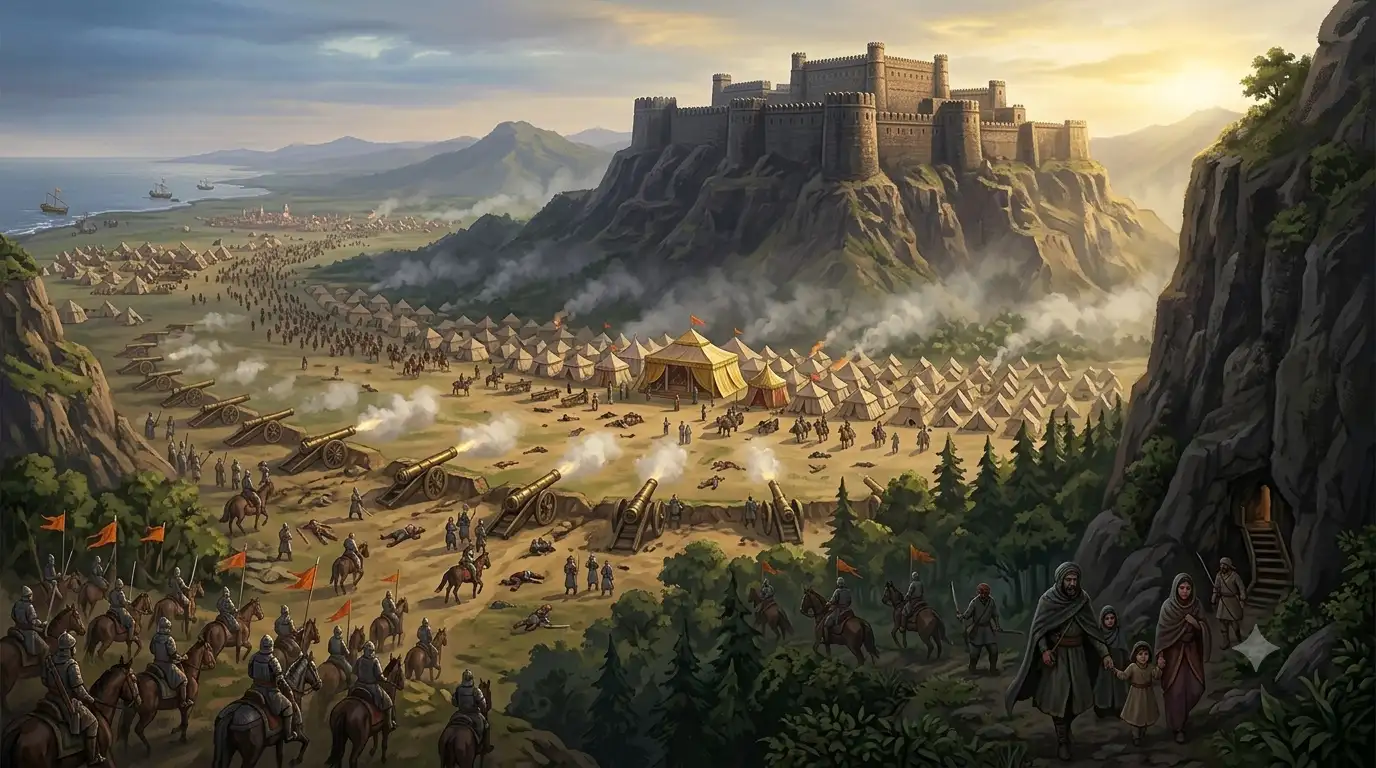
Without delay at Bhor, Firuz Jang continued his advance toward Raigad through Pali, determined to capture the Maratha capital before Sambhaji Maharaj could return from Pune. As the Mughal army neared Raigad, the Maratha garrison made a critical mistake. Instead of remaining behind the fort's powerful defenses and forcing the Mughals into a prolonged siege, the garrison commander chose to confront the enemy in the open country between Pali and Raigad. The Maratha force was heavily outnumbered, and Firuz Jang responded with coordinated cavalry, infantry, and artillery formations. Mughal guns disrupted the Maratha advance while imperial cavalry attacked both flanks. After several hours of fierce fighting, the Maratha defenders were routed and forced to retreat into the surrounding hills.
With the defending force defeated, the road to Raigad lay open. Firuz Jang quickly surrounded the capital and occupied it before substantial Maratha reinforcements could arrive. However, the Mughals failed to secure their greatest objective. Before the city fell, members of Sambhaji Maharaj's family escaped through secret routes known only to trusted Maratha officers. His wife, young son, and several close relatives were safely evacuated into Maratha-controlled territory. Although Aurangzeb's army captured Raigad, the Maratha royal family remained free. The loss of the capital dealt a major symbolic blow to Swarajya, but the survival of the royal dynasty ensured that resistance against the Mughal Empire would continue.
The capture of Raigad marked a turning point in the campaign. With the Maratha capital under Mughal control and Sambhaji Maharaj forced to withdraw, Aurangzeb moved quickly to strengthen his gains before the Marathas could recover. He once again entrusted Zulfiqar Khan with a major command, reinforcing him with fresh troops and ordering him to march from Supa toward Pune. His mission was to eliminate the remaining Maratha resistance and secure control of the region. At the time, Maratha forces around Pune were disorganized after the fall of Raigad, with many units retreating to nearby hill forts while others attempted to regroup under local commanders.
Taking advantage of this situation, Zulfiqar Khan advanced rapidly. Near Jejuri, the Mughals encountered a scattered Maratha force attempting to delay their progress. Outnumbered and lacking coordination, the defenders were unable to withstand the attack and retreated into the surrounding hills after a brief battle. With the road clear, Zulfiqar Khan marched into Pune without facing a major engagement. Sambhaji Maharaj had already left the region and moved toward Vishalgad to avoid being trapped between the Mughal armies operating from Pune and Raigad.
At Vishalgad, Sambhaji reunited with his family, who had escaped before the fall of Raigad. Although the loss of both Raigad and Pune was a major setback, the Chhatrapati remained free, his family was safe, and many of the strongest Maratha forts were still under his control. By the end of the campaign, the Mughals held Raigad and Pune, while Sambhaji established his new headquarters at Vishalgad. The war was far from over, but for the first time since Sangameshwar, Aurangzeb could claim a major strategic success against Swarajya.
The loss of Raigad, Pune and Shirwal created deep despair among many Maratha nobles. Some believed Swarajya could no longer continue its struggle against the vast Mughal Empire, while others feared that further resistance would only bring greater destruction to the land and its people. At Vishalgad, several advisors quietly urged Sambhaji Maharaj to open negotiations with Aurangzeb, arguing that a settlement might preserve what remained of the kingdom. Some even suggested that the Chhatrapati personally submit to the emperor in exchange for favorable terms. Sambhaji rejected every proposal without hesitation, refusing to consider surrender under any circumstances.
Standing before his commanders, Sambhaji declared that he would never bow before Aurangzeb. He reminded them that Swarajya had been built through sacrifice, courage, and struggle, not through submission. He warned that abandoning the fight would destroy everything Shivaji Maharaj had achieved. Declaring that he would rather die with a sword in his hand than live as Aurangzeb's servant, he insisted that forts might fall and cities might be occupied, but Swarajya would survive as long as its people retained the courage to fight. His words transformed the atmosphere inside Vishalgad. What had begun as a council of despair became a council of renewed resistance, with the commanders pledging their loyalty and preparing for the next phase of the war. Though the Mughals controlled the cities and major roads, the Marathas still had their king, and as long as Sambhaji remained free, the struggle against Aurangzeb was far from over.
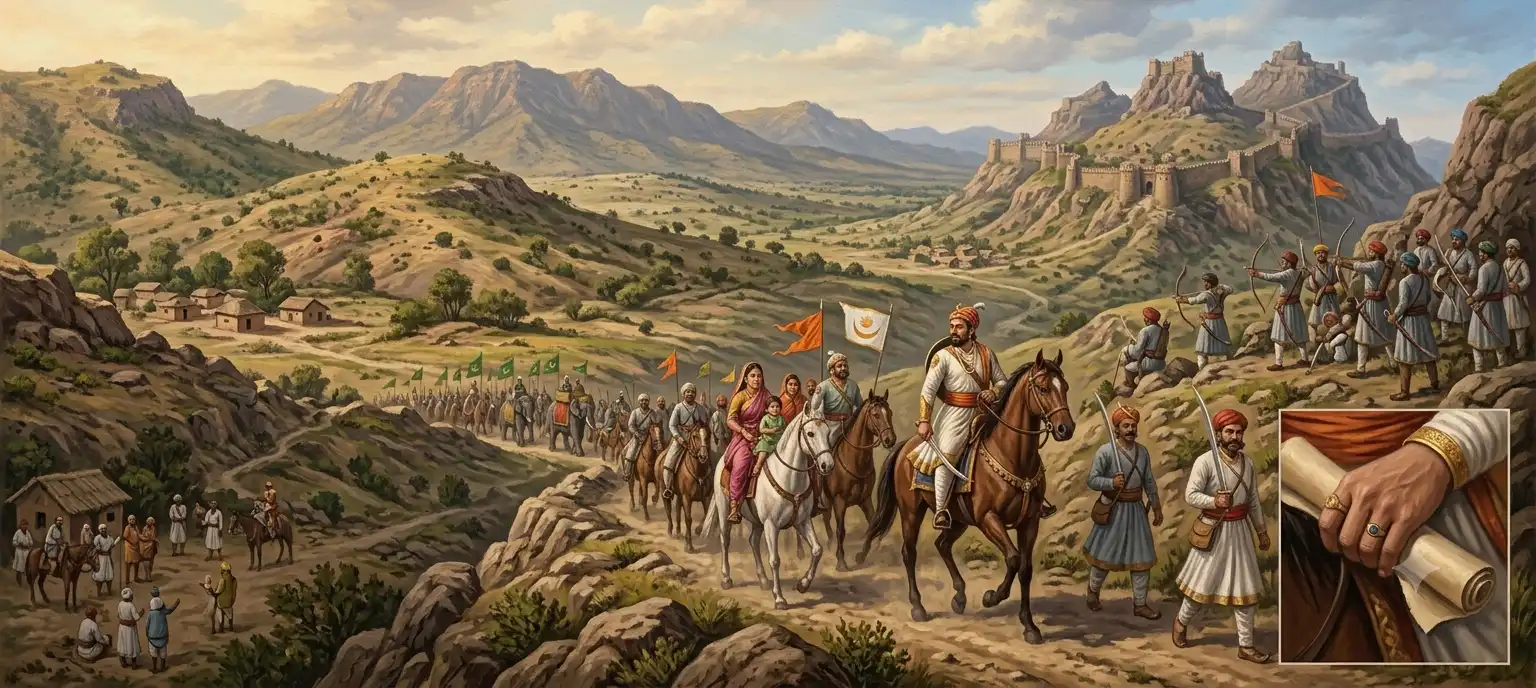
After securing Satara, Zulfiqar Khan continued his advance and occupied Karad. The Mughal army faced little organized resistance as it pushed deeper into southern Maharashtra, opening the road toward Vishalgad. Sambhaji Maharaj carefully assessed the situation and realized that confronting the advancing Mughal forces near Vishalgad could lead to the destruction of the remaining Maratha field army. Determined to preserve his strength for a long struggle, he chose not to defend the region. Instead, he choose a strategic withdrawal to ensure the survival of his army and leadership.
Leaving a small but determined garrison inside Vishalgad, Sambhaji departed with his family, senior commanders, and the main Maratha force, marching south into territories where Mughal influence remained weak and local chiefs continued to support Swarajya. The garrison was ordered to defend the fort for as long as possible, not to defeat the Mughals but to delay their advance and give Sambhaji time to reorganize his forces and prepare a new strategy. As the Chhatrapati moved south, many Mughal commanders believed the Marathas were nearing collapse. Sambhaji, however, saw the campaign differently. Though he had lost cities, forts, and territory, he still possessed the loyalty of his followers, the mobility of his army, and the ability to continue the war. The struggle for Swarajya was entering a new phase.
The small Maratha garrison left at Vishalgad resisted the Mughal siege for several months. Despite being cut off from outside support, the defenders continued to hold the fort, delaying the Mughal advance and preventing a quick victory. Over time, however, food supplies were exhausted, and conditions inside the fort became increasingly desperate. As starvation spread through the garrison and no relief force arrived, the fort commander concluded that further resistance was no longer possible.
After months of determined defense, the Maratha garrison surrendered Vishalgad to the Mughals. Aurangzeb's forces occupied the fort and celebrated another important victory in the campaign. However, Sambhaji Maharaj had already escaped to the south with the main Maratha army, preserving the Maratha leadership and ensuring that the struggle against the Mughal Empire would continue despite the loss of another major fort.
With Vishalgad secured and Firuz Jang joining the main operations after marching through Mahad, Khed, Chiplun, Sangameshwar, and the Malkapur region, the Mughal command in western Maharashtra became more coordinated. Aurangzeb ordered his commanders to consolidate their recent gains before launching a deeper pursuit of Sambhaji Maharaj into southern territories. The first objective was Panhala Fort. Zulfiqar Khan, advancing from the Satara–Karad region, and Firuz Jang, positioned near the Western Ghats, were instructed to unite their forces and capture the fort, which controlled access to southern Maharashtra and remained a key Maratha stronghold.
Aurangzeb's plan after securing Panhala was to stabilize the occupied territories by strengthening Mughal garrisons at Raigad, Pune, Satara, Karad, Vishalgad, and nearby regions while protecting supply lines. Only after consolidating these gains would the Mughal armies continue their advance south in search of Sambhaji Maharaj, who had withdrawn with his remaining forces deeper into Maratha territory. The campaign had entered a new phase. The rapid conquests of earlier months had given the Mughals control of important forts and cities, but their priority now shifted to securing and organizing these territories. Despite these successes, Aurangzeb's ultimate objective remained unchanged—the complete defeat of the Maratha resistance and the capture of Sambhaji Maharaj.
After earlier successes in the Konkan and Firuz Jang’s return from the western route, Mughal confidence in the Deccan rose once again. The capture of key forts and the weakening of Maratha control over the central region convinced many commanders that Maratha resistance was nearing collapse. Stationed at Vishalgad, Firuz Jang selected Panhala as his next objective. Believing the Marathas were too scattered to offer serious resistance, he advanced with a force of around fifteen thousand troops, hoping to capture the fort before Sambhaji Maharaj’s forces could respond. As the Mughal column moved through the narrow forests and rugged hills between Vishalgad and Panhala, Santaji Ghorpade began shadowing its advance with fast-moving cavalry.
Maratha units repeatedly struck the edges of the Mughal column, attacking scouts, supply carts, and isolated detachments before disappearing into the hills. These constant raids stretched the Mughal formation and disrupted its cohesion as it pushed deeper into hostile territory. Within days, Santaji intensified the attacks, launching night raids that further weakened the advancing force and disrupted communication with the rear camps. Firuz Jang’s position became increasingly unstable as he found himself under constant pressure and cut off from full support. Recognizing the growing danger, Zulfiqar Khan dispatched reinforcements from the main Mughal army to stabilize the situation. Their arrival prevented a complete disaster and forced Santaji to withdraw temporarily from direct engagement.
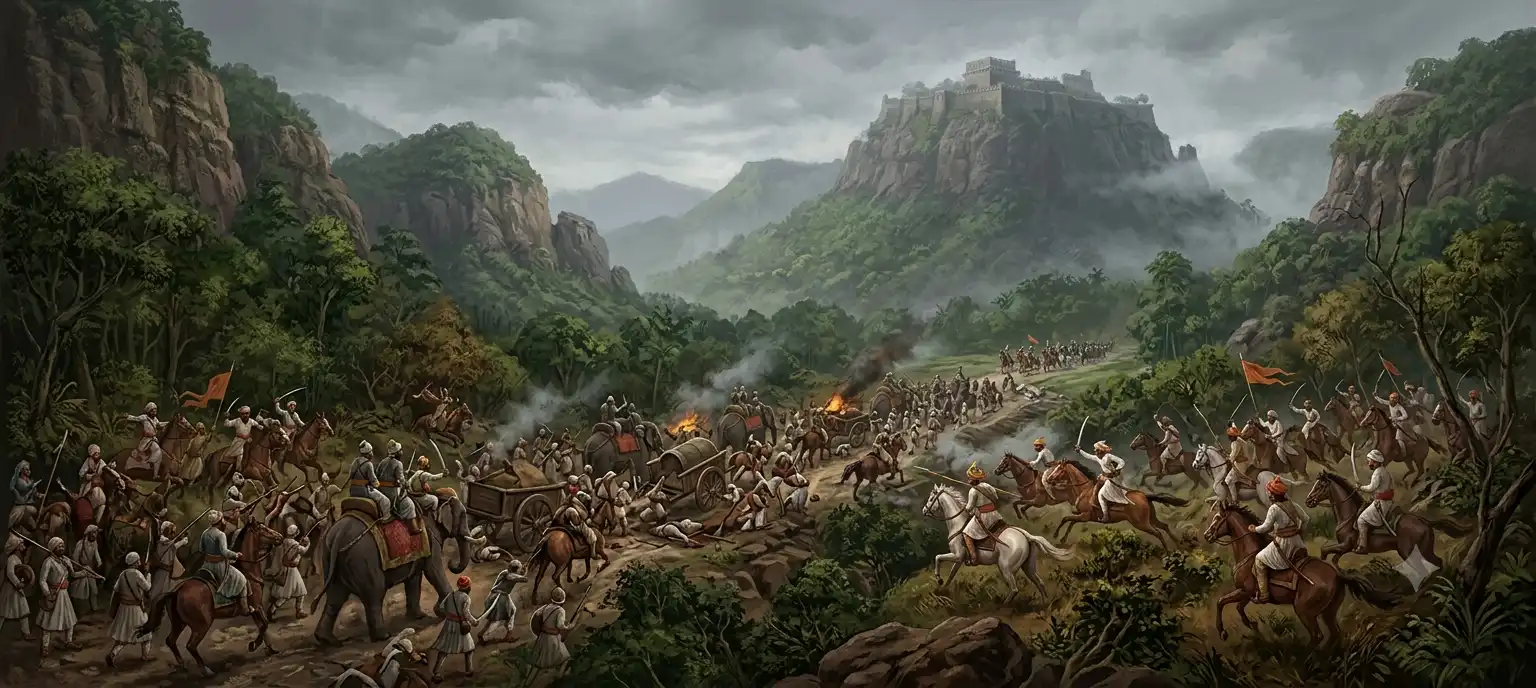
Shaken by the campaign and realizing the dangers of advancing too far with a reduced force, Firuz Jang abandoned the attempt on Panhala and retreated with his remaining troops to Vishalgad, where the Mughal command regrouped and reassessed its strategy. The failed advance exposed the limits of Mughal confidence in the difficult terrain of western Maharashtra. Despite earlier victories, the Maratha cavalry remained highly effective, proving that no Mughal advance through the region could succeed without careful planning, strong support, and constant vigilance.
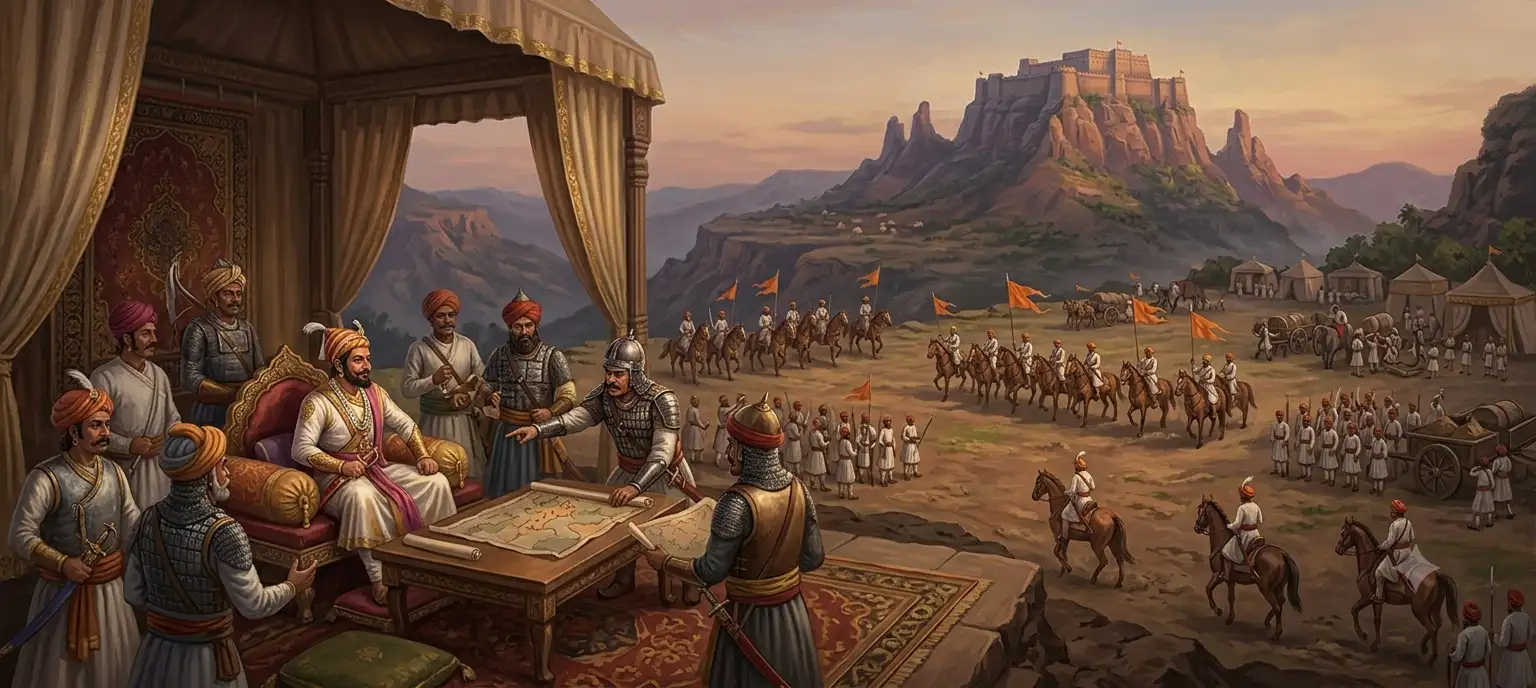
Sambhaji Maharaj reached the Kolhapur region after withdrawing from the northern forts. Growing Mughal pressure across Maharashtra had made Vishalgad and the surrounding strongholds unsuitable as secure centers of command. Kolhapur became his temporary headquarters, where he focused on regrouping the Maratha leadership and rebuilding military strength. From there, Sambhaji began gathering scattered Maratha forces, recalling trusted commanders, and restoring communication with local chiefs who continued to resist Mughal rule. Rather than seeking an immediate confrontation, he concentrated on preparing the army for a sustained campaign.
Small Maratha units were reorganized into larger formations, supply routes from the southern countryside were reopened, and loyal sardars received orders to harass Mughal garrisons at Satara, Karad, and Pune whenever opportunities arose. Despite the recent loss of major forts, Sambhaji remained determined. He understood that although the Maratha position had weakened, the struggle for Swarajya was far from over. From Kolhapur, plans were laid to gradually recover lost territory, restore pressure on Mughal-held regions, and rebuild the strength needed for future campaigns. For Sambhaji, the move to Kolhapur was not a retreat, but the beginning of a new phase of the war.
Aurangzeb shifted his main camp from Suru to Pune to strengthen his control over the Deccan campaign. From Pune, Mughal spies soon reported that Sambhaji Maharaj had established himself in the Kolhapur region, where he was rebuilding his forces after recent setbacks. Acting on this intelligence, Aurangzeb improved coordination between the Mughal armies stationed at Satara, Karad, and Vishalgad, preparing for a renewed offensive into southern Maharashtra. With Sambhaji’s location confirmed, the Mughal focus shifted decisively toward the southern front. Fresh reinforcements were dispatched to Vishalgad to strengthen the forward commanders and secure Mughal positions across western Maharashtra.
Along with the reinforcements, Aurangzeb issued clear orders for a coordinated southern advance. Firuz Jang was instructed to move first and capture Panhala Fort, a vital stronghold controlling access to the Kolhapur region. Securing Panhala would stabilize the Mughal left flank and restrict Maratha movement through the ghats. At the same time, Zulfiqar Khan received orders to advance directly toward Kolhapur through Karad and Peth Vadgaon. This two-pronged strategy was designed to pressure Sambhaji Maharaj from multiple directions, prevent him from rebuilding his forces, and tighten Mughal control over southern Maharashtra before the Marathas could regain the initiative.
From Kolhapur, Sambhaji Maharaj anticipated that Firuz Jang would target Panhala Fort first. He reinforced the fort with additional troops from Kolhapur and nearby detachments while assigning Santaji Ghorpade to defend the approaches with his fast cavalry. Santaji was ordered to strike Mughal scouts, disrupt supply lines, and attack isolated units before they reached Panhala. Inside the fort, the garrison strengthened its defenses and prepared for a prolonged siege, while Santaji’s mobile forces kept constant pressure on the surrounding routes. The strategy combined a strong defense inside the fort with continuous cavalry attacks outside, aiming to force the Mughals into a costly campaign.
Firuz Jang advanced toward Panhala again, this time with nearly 40,000 troops and a far more disciplined army than before. Santaji repeatedly attacked the Mughal flanks and rear, but Firuz Jang had reorganized his forces into a strong defensive formation. The army marched in a wide outer square formation capable of resisting attacks from any direction, while a second circular defensive ring protected the center. Supply wagons and reserve troops remained safely enclosed within these formations. Despite repeated cavalry strikes, Santaji failed to break the Mughal defenses or significantly disrupt the advance. Realizing further harassment would achieve little, he withdrew and moved toward Panhala to reinforce the defenders as Firuz Jang prepared to begin the siege.
A second Mughal army of nearly 70,000 men under Zulfiqar Khan advanced from Karad toward Kolhapur through Peth Vadgaon. With overwhelming numbers and disciplined formations, the army moved steadily across the open terrain. Sambhaji Maharaj, stationed in the Kolhapur region with a reduced force, carefully assessed the situation and recognized that fighting a major battle on the plains would place the Marathas at a severe disadvantage. Rather than risk the destruction of his remaining army, he decided to withdraw south with his troops toward the Belagavi frontier, preserving his forces and maintaining the flexibility needed for future operations.
Facing little organized resistance, Zulfiqar Khan entered Kolhapur and brought the region under Mughal occupation. Imperial banners were raised over the city, marking another important territorial success in the Deccan campaign. Although the Mughals gained control of Kolhapur, Sambhaji’s strategic withdrawal ensured that the Maratha army remained intact. Instead of ending the conflict with a decisive victory, the Mughal advance pushed the war farther south into more difficult terrain, where Maratha resistance would continue beyond the empire’s immediate reach.
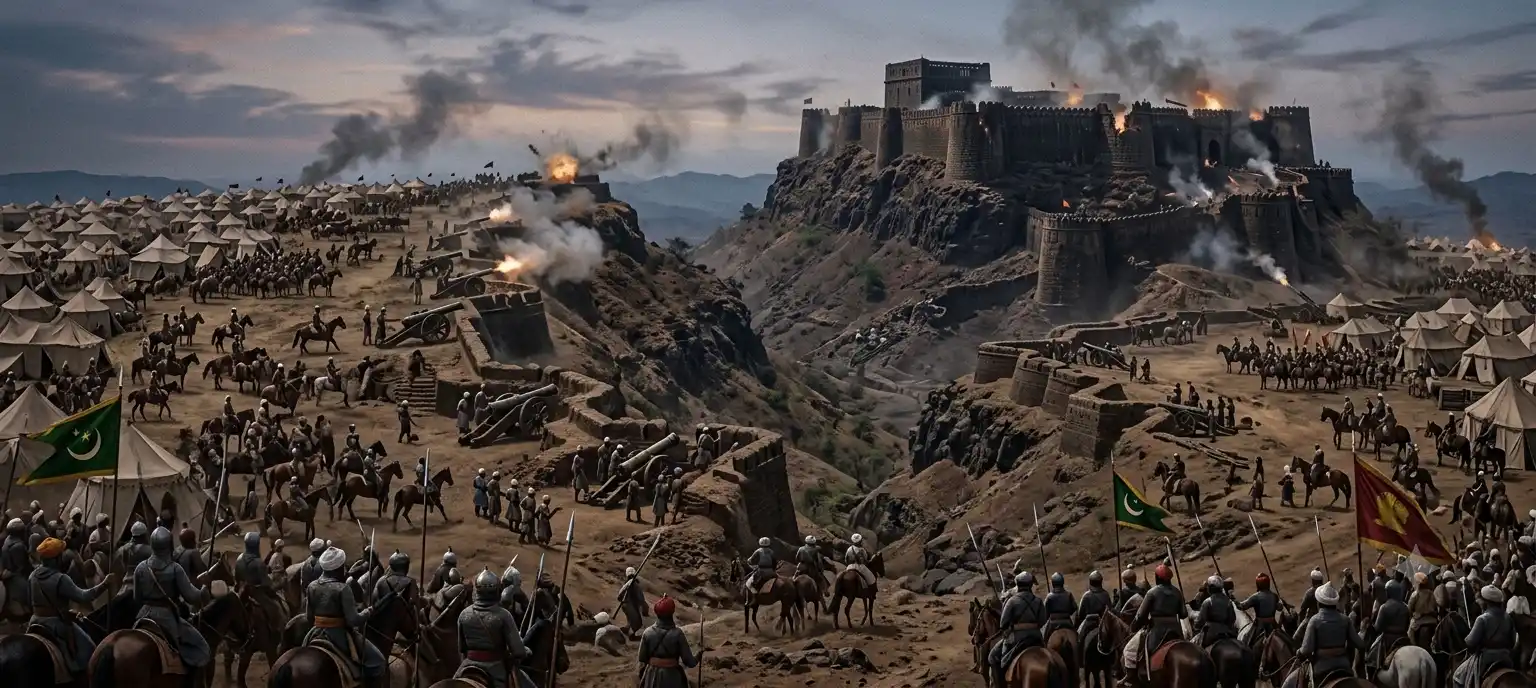
The siege of Panhala Fort began when Firuz Jang surrounded the fort with a large Mughal army and cut off all supply routes. Isolated and without hope of immediate relief, the Maratha defenders prepared for a prolonged resistance. Firuz Jang established siege camps around the fort, positioned artillery on nearby heights, and launched initial assaults to test the outer defenses and force a quick surrender. The defenders used Panhala’s elevated position and narrow approaches to repel these attacks. Meanwhile, Santaji Ghorpade operated outside the siege lines, striking Mughal supply routes and disrupting communication between their camps. As the weeks passed, Firuz Jang tightened the blockade by constructing fortified positions that prevented supplies, escape, or reinforcements from reaching the fort. Inside Panhala, food was carefully rationed, discipline remained strict, and the defenders relied on the fort’s natural strength while Santaji’s raids forced the Mughals to constantly protect their rear.
The siege gradually turned into a long war of endurance lasting several months. Mughal artillery damaged sections of the outer walls, but repeated assaults failed because of the steep terrain and determined Maratha resistance. The defenders launched occasional night raids, destroying siege works and inflicting losses on Mughal camps, yet the lack of reinforcements steadily weakened their position. After six to eight months of continuous siege, food supplies were nearly exhausted, and starvation threatened the garrison. Realizing that further resistance would lead only to complete destruction, the remaining defenders either surrendered or were overwhelmed as Mughal forces finally secured Panhala. Firuz Jang's victory strengthened Mughal control over the region, though it came at the cost of considerable time and manpower. During the final phase of the siege, Santaji Ghorpade attempted to escape the tightening Mughal blockade but was captured and taken prisoner, dealing a major blow to Maratha operations in the region.
After securing Kolhapur, Zulfiqar Khan advanced toward Belagavi in search of Sambhaji Maharaj. Determined to avoid a decisive battle against the much larger Mughal army, Sambhaji relied on the rugged terrain between Kolhapur and Belagavi to wage a war of attrition. Maratha cavalry repeatedly struck the advancing Mughal column, ambushing scouts, attacking supply convoys, and destroying isolated detachments before disappearing into the hills and forests. These swift raids forced Zulfiqar Khan to move with greater caution and assign large numbers of troops to protect his baggage train and supply lines throughout the march.
Although Sambhaji’s attacks did not completely stop the Mughal advance, they slowed it significantly. A march that was expected to be rapid turned into a difficult and exhausting campaign as the Mughals faced continuous harassment, steady casualties, and repeated logistical disruptions. By the time Zulfiqar Khan finally approached the Belagavi region, his army had endured considerable delays and losses, demonstrating that the Marathas remained capable of challenging even a much larger imperial force through mobility, terrain, and relentless guerrilla tactics.
While Sambhaji Maharaj was occupied with slowing Zulfiqar Khan's advance toward Belagavi, Firuz Jang launched a separate operation from Panhala. Instead of following the expected route through Kolhapur, he chose a more difficult but less guarded path through the western forests. Marching through the Vishalgad forests, Radhanagari, Ajra, and Chandgad, Firuz Jang steadily advanced towards Khanapur. Under normal circumstances, such a route would have faced constant Maratha attacks, but with Santaji Ghorpade already captured and Sambhaji's forces heavily engaged against Zulfiqar Khan, the Mughal column encountered little resistance during its advance.
When news reached Sambhaji that Firuz Jang had arrived near Chandgad, he immediately recognized the danger. If Firuz Jang reached Khanapur, he could advance on Belagavi from the south-west while Zulfiqar Khan continued pressing from the north, trapping the Maratha army between the two Mughal forces. Determined to avoid encirclement and preserve his remaining army, Sambhaji abandoned Belagavi before the Mughal plan could be completed and ordered a rapid withdrawal toward the southern edge of his territories. Once again, the Mughals gained territory, but Aurangzeb's greatest objective—the capture of Sambhaji Maharaj—remained beyond his reach.
As Sambhaji Maharaj withdrew farther south, he faced the most difficult period of his reign. Within a few years, the Mughals had captured Raigad, Pune, Satara, Karad, Vishalgad, Panhala, Kolhapur, and much of the Maratha heartland. Forts that once flew the saffron flag were now occupied by imperial garrisons. Years of campaigning, sieges, and defeats had also reduced the Maratha army to a small force of loyal soldiers and chiefs who refused to abandon their king. The threat extended beyond the loss of territory, as Mughal armies advanced from multiple directions, with Zulfiqar Khan and Firuz Jang steadily closing the remaining escape routes.
Many advisers believed the situation had become hopeless. They argued that most of the kingdom had been lost, the Mughals possessed overwhelming resources, and fresh imperial armies continued to arrive from the north. Some quietly urged Sambhaji to negotiate before it was too late. Sambhaji, however, firmly rejected surrender. He knew that capture would almost certainly lead to imprisonment, humiliation, and execution under Aurangzeb's orders. Despite losing much of his kingdom and seeing his army greatly reduced, he remained determined to continue the struggle. The Mughals had taken his forts and territory, but they had failed to take his freedom, his resolve, or the loyalty of the men who still stood beside him. This was the darkest hour of Sambhaji Maharaj's reign, and the greatest test of his determination.
The situation in Belagavi was rapidly deteriorating. With Zulfiqar Khan closing in from the north and Firuz Jang advancing from the east, Sambhaji Maharaj knew that remaining within the city walls meant certain capture. He made the painful decision to sacrifice his remaining vanguard, ordering his loyal commanders to divide into small guerrilla units with one objective: disrupt Mughal supply lines, create confusion, and buy him enough time to escape. While his men rode out to face a hopeless situation, the Chhatrapati abandoned every symbol of his royal identity. He left behind his silk robes, jeweled turban, and weapons, dressing instead in the coarse saffron robes of a wandering pilgrim and carrying only a brass begging bowl. Under the cover of midnight, accompanied by only a handful of trusted guards disguised as pilgrims, he slipped into the dense southern forests.
The journey toward the independent kingdom of Keladi became a relentless struggle for survival. Aurangzeb had flooded the major trade routes with search parties, and hand drawn pictures describing Sambhaji’s appearance were displayed at village crossroads across the region. Avoiding roads entirely, the fugitives traveled only at night through rocky riverbeds, thick jungles, and difficult mountain paths. On one occasion, a Mughal cavalry patrol passed only a few yards from where Sambhaji lay hidden among the bushes. 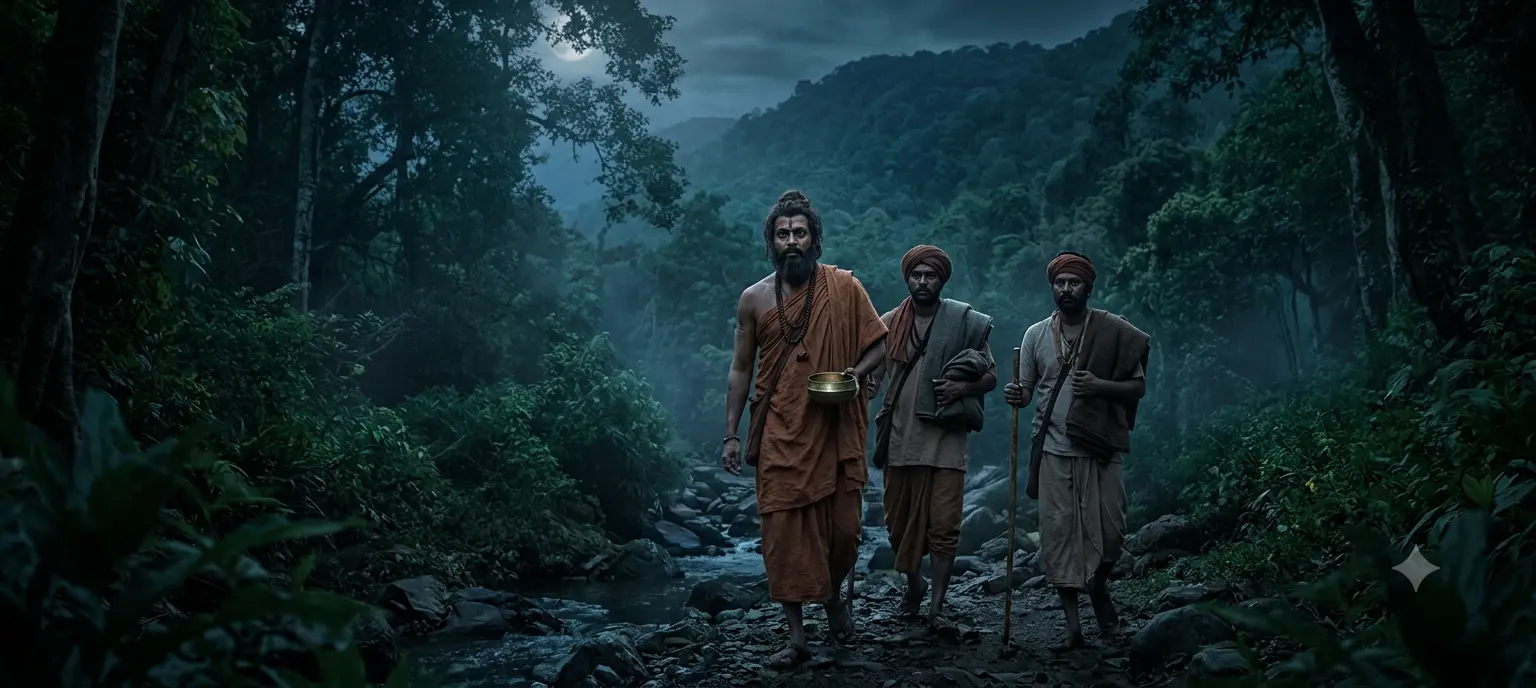
After weeks of exhausting travel, Sambhaji and his companions finally crossed into Keladi territory. To avoid attracting attention, he sought refuge at a large temple complex visited by pilgrims from across the subcontinent. He spent his days among the poor, surviving on temple rations and accepting alms with his begging bowl. Despite the dirt and ragged clothing, his commanding voice, military scars, and quiet dignity gradually drew the attention of regular worshippers. As weeks passed, some of his followers became impatient and suggested approaching the royal court directly, but Sambhaji rejected the idea, knowing that Keladi was filled with Mughal spies and that any open attempt to contact the palace could end in immediate arrest.
Eventually, reports about the mysterious "royal beggar" reached the Keladi intelligence network. Agents observed that the stranger spoke with the refined dialect of a Maratha noble and possessed the bearing of an experienced commander. One moonless night, three men dressed in plain clothes approached Sambhaji in the temple courtyard. Without speaking a word, they bowed deeply, silently acknowledging his true identity, and escorted him through hidden jungle paths that bypassed the public guards before bringing him into the private chambers of Queen Chennamma. The meeting was held in complete secrecy, without any royal ceremony or public announcement.
Sambhaji openly described the disastrous state of the Maratha kingdom, recounting the fall of Pune, the siege of Raigad, and the loss of major forts such as Satara and Panhala. Looking directly at the queen, he admitted that he had lost his kingdom, forts, and treasury, but insisted that the spirit of Swarajya remained alive. He explained that he had come to Keladi not to remain in hiding, but to establish a secure base from which the Maratha resistance could be rebuilt. Queen Chennamma understood the gravity of the request. Granting asylum to the most wanted man in India meant openly defying Aurangzeb and risking a devastating Mughal invasion that could destroy her own kingdom. Yet she also recognized that if Sambhaji and the Maratha resistance were crushed, Keladi would lose its protective buffer and inevitably become the next target of the Mughal Empire.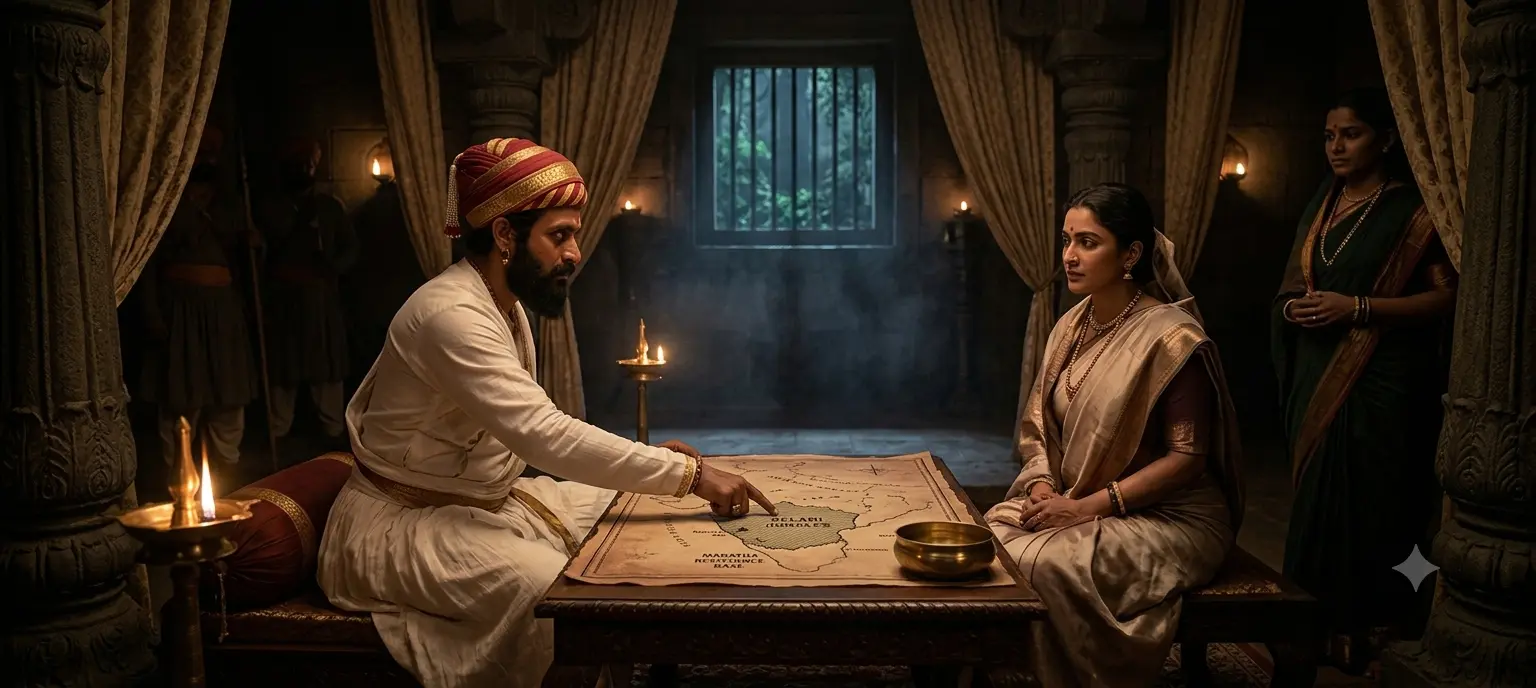
Breaking the silence, Queen Chennamma declared that a king fighting for the freedom of his people would never be turned away from Keladi's gates and affirmed that her kingdom would honor its word regardless of Aurangzeb's response. Before sunrise, Sambhaji and his followers were secretly relocated to a secluded, heavily guarded palace deep within the Western Ghats. There he received clean clothes, fresh horses, and reliable supplies. For the first time in months, the Maratha ruler was able to rest without fearing the approach of Mughal scouts. Even as Aurangzeb's forces searched across Maharashtra for the missing Chhatrapati, Sambhaji was already studying maps within the forests of Keladi, preparing the plans that would one day guide his return.
After occupying Belagavi and Khanapur, Zulfiqar Khan and Firuz Jang launched an extensive search for Sambhaji Maharaj. Scouts were dispatched across the countryside, villages were questioned, and every suspected hideout was thoroughly investigated in an effort to locate the Maratha ruler. Despite these widespread operations, however, no trace of Sambhaji could be found. Weeks gradually turned into months, and reports continued to arrive in Pune, but none offered reliable information about his whereabouts. Some claimed he had disappeared deep into the forests, while others believed he had escaped into the territories of the southern kingdoms. None of these reports could be confirmed, leaving the Mughal commanders without any clear direction.
The failure to capture Sambhaji deeply frustrated Emperor Aurangzeb. Although the Mughal Empire had occupied much of the Maratha kingdom, seized many important forts, and forced Sambhaji to abandon one refuge after another, the emperor's principal objective remained unfulfilled. The Maratha king, whom Aurangzeb considered the key to ending resistance in the Deccan, had once again slipped beyond Mughal reach. Determined to secure his capture, Aurangzeb sent sharp messages to both Zulfiqar Khan and Firuz Jang, reminding them that controlling forts and territory meant little if Sambhaji remained free. He demanded immediate results and ordered both generals to intensify their search with even greater determination. Despite mounting imperial pressure and continued search operations, neither commander succeeded in discovering Sambhaji's location. For all the Mughal victories achieved on the battlefield, the war remained unfinished. Sambhaji had lost much of his kingdom, many of his forts, and most of his resources, but as long as he remained alive and uncaptured, the possibility of reviving Maratha resistance against Mughal rule continued to exist.
Under the protection of Queen Chennamma, Sambhaji Maharaj finally found a secure refuge after years of continuous warfare. Accompanied by his wife and young son Shahu, he remained hidden within the Keladi kingdom while Mughal armies searched unsuccessfully for him across the Deccan. The queen provided shelter, food, and security for Sambhaji, his family, and his loyal followers, allowing the Maratha ruler to focus on rebuilding rather than simply surviving.
Trusted messengers were quietly sent across Maharashtra and Karnataka to contact surviving Maratha commanders and soldiers. As news spread that Sambhaji was alive and safe, scattered warriors gradually made their way south to join him. Though many had lost their forts and lands, they remained devoted to their king. With Queen Chennamma's support, camps were established in secluded locations where the new arrivals were organized into units. Experienced officers took command, recruits received training, and communication networks were gradually restored. Horses, weapons, and provisions were gathered through loyal supporters and resources provided by the Keladi court.
The forests and hills of Keladi offered excellent protection from Mughal spies, enabling the rebuilding effort to continue with little interference. Month after month, the number of men serving under Sambhaji steadily increased. What had begun as a small band of exhausted fugitives slowly evolved into a disciplined military force. Although still much smaller than Aurangzeb's armies, Sambhaji once again possessed an effective command structure, trained troops, and a growing base of loyal supporters. By the end of this period, he was no longer a hunted king travelling with only a handful of followers. With his family secure under Queen Chennamma's protection and a new army taking shape around him, Sambhaji was steadily restoring the strength needed for the struggle that lay ahead.
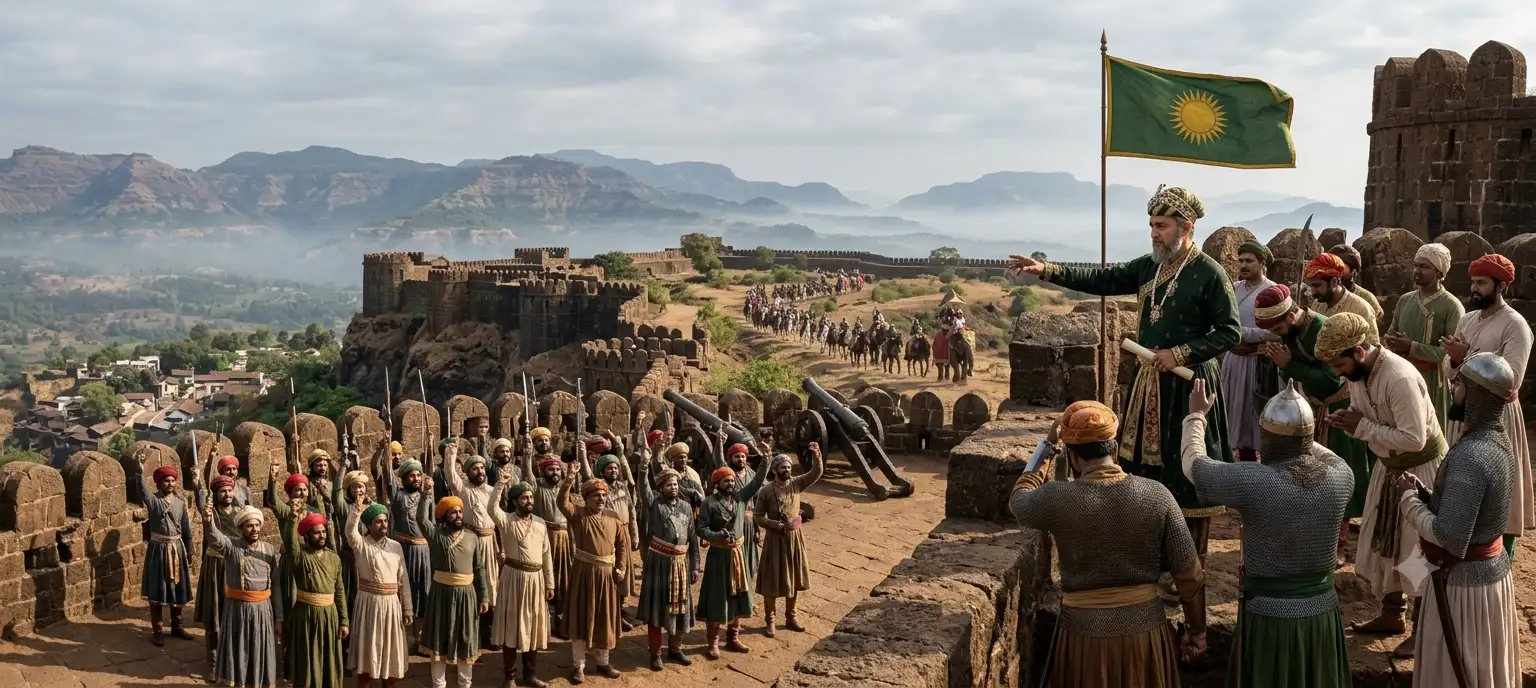
After months of searching, Aurangzeb received no reliable information about Sambhaji Maharaj's whereabouts. With no trace of the Maratha ruler and no major resistance emerging from the south, many within the Mughal camp came to believe that Sambhaji had either perished during his escape or died somewhere in the forests. Convinced that the threat had effectively disappeared, Aurangzeb decided to end the costly search. He ordered both Zulfiqar Khan and Firuz Jang to withdraw from the southern frontier and return to the Mughal-controlled regions of Maharashtra.
From his position at Raigad, the emperor proclaimed that the Maratha kingdom had been defeated and that Mughal authority now prevailed across the region. The capture of the principal forts and major cities was presented as proof that the Maratha state had ceased to exist as a meaningful political and military power. Confident that no serious challenge remained, Aurangzeb reduced the Mughal military presence in the far south, leaving only a relatively small force to guard the frontier around the Belagavi–Khanapur region and monitor any signs of renewed Maratha activity. To the Mughal court, the long struggle appeared finished. The Maratha capital was occupied, their forts were in imperial hands, and their king had vanished without leaving a trace. Few realized that Sambhaji was still alive, rebuilding his strength under the protection of Queen Chennamma and patiently waiting for the right moment to return.
Over the following years, Sambhaji Maharaj steadily rebuilt his strength under the protection of Queen Chennamma. With her continued support, Maratha refugees, soldiers, and commanders arrived from different parts of the Deccan. Many chiefs who had gone into hiding after Sambhaji's disappearance also emerged and once again pledged their loyalty to their king. As more men joined his cause, the Maratha force grew into a large and well-organized army. What had once been a small band of fugitives gradually developed into a force of more than fifty thousand troops, led by experienced commanders who had survived the Mughal conquest of Maharashtra.
Believing that the time for complete secrecy had passed, Sambhaji decided to leave Keladi territory. Accompanied by his rebuilt army, he advanced north and established a major camp within the dense forests surrounding Joida. The selection of Joida was carefully planned. Its thick forests and rugged terrain concealed the true strength of the Maratha army while shielding it from Mughal observation. At the same time, the location lay close enough to the Belagavi–Khanapur frontier to threaten Mughal positions while remaining difficult for enemy forces to penetrate. From this hidden base, Sambhaji and his commanders carefully assessed the political and military situation. For years, the Mughals had believed that the Maratha king was either dead or permanently lost. Now, deep within the forests of Joida, a powerful Maratha army was gathering beyond their knowledge, preparing for the next phase of the struggle.
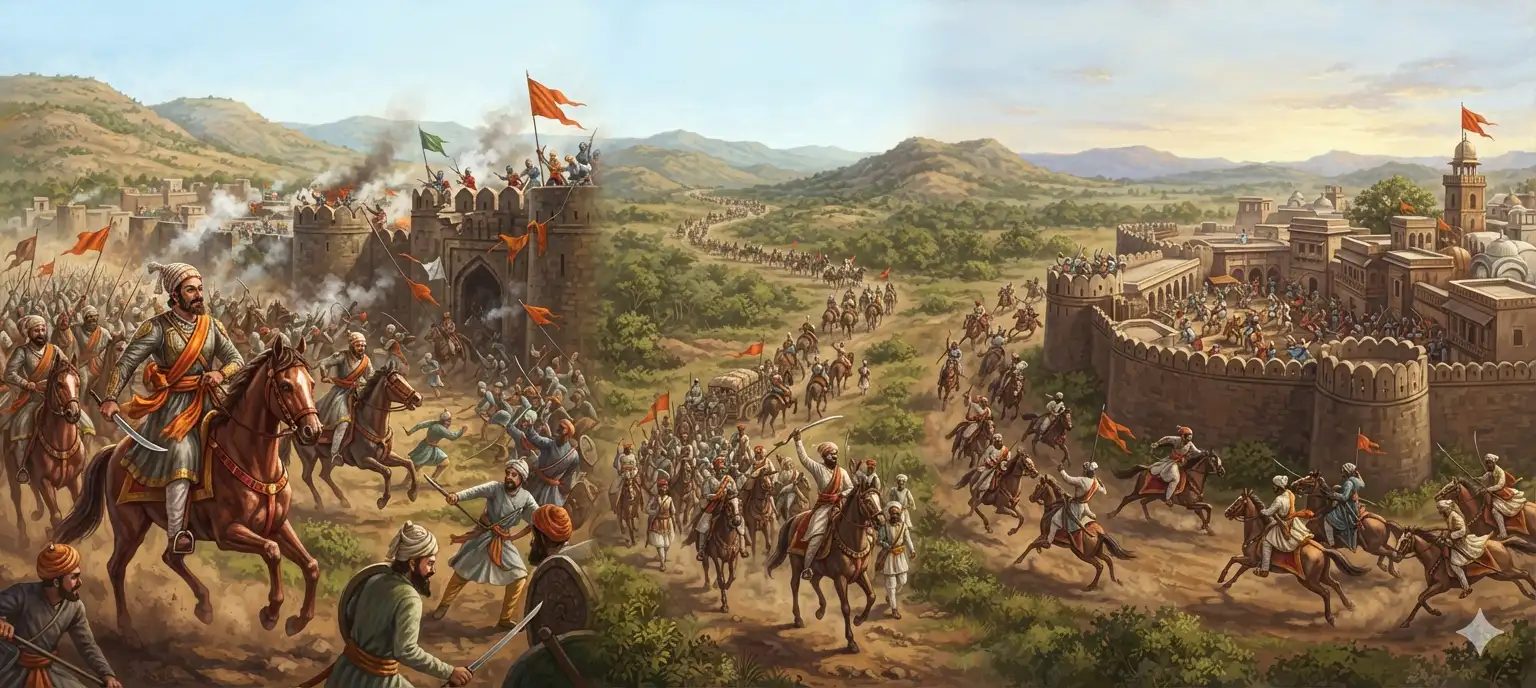
After years of rebuilding his strength in secrecy, Sambhaji Maharaj decided the time had come to return to the battlefield. Leaving his hidden camp in the forests of Joida, he marched north with his newly raised army through Khanapur toward Belagavi. The Mughal garrison, complacent after years without significant Maratha activity, had no idea that a powerful force was approaching. The Marathas launched a sudden assault before the defenders could organize. Overwhelmed by the unexpected attack, the Mughal garrison collapsed after a brief but fierce battle, with many soldiers fleeing while others were captured, allowing Belagavi to return to Maratha control. The victory sent shockwaves across the region, as many had believed Sambhaji was dead, captured, or permanently defeated. His dramatic return at the head of a strong army astonished both allies and enemies. The local population welcomed the restoration of Maratha rule, providing food, guides, and fresh recruits, while former supporters openly renewed their loyalty. For the first time since his disappearance, Sambhaji had openly returned, his growing army marking the beginning of a renewed struggle to reclaim his kingdom.
Determined to maintain the momentum, Sambhaji immediately entrusted the next campaign to his most capable surviving commander, Dhanaji Jadhav, whose mastery of fast-moving warfare had earned him a formidable reputation among friend and enemy alike. Leading a strong Maratha force, Dhanaji advanced rapidly toward Kolhapur, keeping his destination secret and giving the Mughals little time to react. The Mughal garrison, having only recently heard reports of Sambhaji's return, did not expect another offensive so soon. Striking before the defenders could fully prepare, Maratha cavalry surrounded the city, cut communications, and attacked key positions simultaneously. The surprise assault threw the Mughal troops into confusion, and before reinforcements could arrive, their resistance collapsed. By the end of the operation, Kolhapur had returned to Maratha control. The victory strengthened Sambhaji's position, restored an important base in southern Maharashtra, and demonstrated that the Maratha revival was not a temporary uprising but a determined campaign capable of seriously challenging Mughal rule.
After securing Kolhapur, Dhanaji Jadhav wasted no time and advanced against Panhala. The fort was heavily defended by a Mughal garrison and could not be captured through a simple frontal assault. Remembering the difficulties faced during the earlier attempts to capture the fortress, Dhanaji chose patience over recklessness. The Marathas surrounded Panhala and cut off the main routes leading to it. Small detachments occupied nearby hills to intercept messengers and cut supply routes. Rather than risking heavy losses by attacking the walls directly, Dhanaji focused on weakening the defenders from within.
Unknown to the Mughal commander, many local servants, laborers, and workers inside the fort still sympathized with the Marathas. Although the Mughals controlled Panhala, these men had remained inside and secretly maintained contact with Maratha agents beyond the walls. Over the following months, they carried out a quiet campaign of sabotage. Grain stores were deliberately soaked with water, food sacks were damaged, and supplies were mishandled so that large quantities became unusable. Small fires also broke out in storage areas under suspicious circumstances. At first, Mughal officers dismissed these incidents as accidents, but the losses steadily increased, making it clear that something was seriously wrong.
As the siege dragged on, conditions within the fort steadily deteriorated. The garrison had expected its provisions to last much longer, but the hidden destruction of supplies created shortages far earlier than anticipated. Rations were reduced, morale declined, and anxiety spread among the defenders. Meanwhile, Dhanaji tightened the blockade even further. Every attempt to bring fresh supplies into Panhala was intercepted, leaving the garrison completely isolated. With food supplies rapidly diminishing and no major Mughal relief force arriving, starvation soon became a greater threat than the Maratha army waiting outside the walls. Realizing that continued resistance was impossible, the Mughal commander opened negotiations. After several months of siege, the garrison surrendered, and the Maratha flag once again flew over Panhala. The recapture of the fort became one of the first major victories of the Maratha revival, restoring a key stronghold, securing the Kolhapur region, and demonstrating that even powerful Mughal garrisons could be defeated through patience, local support, and careful planning.
News of Sambhaji Maharaj's sudden return spread rapidly across the Deccan. Reports of the fall of Belagavi, the recapture of Kolhapur, and the siege of Panhala soon reached the Mughal court. The revelation that Sambhaji was not only alive but once again leading a large army came as a profound shock to Aurangzeb. For years, the emperor had believed that the Maratha ruler had either died in hiding or ceased to be a serious threat. Now, the man he had considered defeated was rapidly rebuilding Maratha power and reclaiming lost territory.
Concerned that Raigad might become the primary target of the renewed Maratha offensive, Aurangzeb decided not to remain there. He withdrew northward to Kalyan, a location that provided better communication with the Mughal territories of the Deccan and northern India while remaining close enough to supervise military operations. Before departing, Aurangzeb entrusted the defense of Raigad Fort and the surrounding region to Zulfiqar Khan. A strong Mughal force was left under his command with clear orders to hold Raigad at all costs and prevent Sambhaji from advancing into the heart of Mughal-controlled territory. Zulfiqar Khan immediately reinforced the fort's defenses, increased patrols along the surrounding routes, strengthened the garrison, and prepared for the possibility of a major Maratha offensive. Additional supplies were stockpiled, while nearby Mughal garrisons were instructed to remain ready for rapid deployment. As Aurangzeb established his headquarters at Kalyan and Zulfiqar Khan fortified Raigad, the conflict entered a new phase. Although the Mughals still controlled much of Maharashtra, their belief that the Maratha challenge had been permanently crushed was shattered. Sambhaji had returned, and both sides now prepared for what promised to be a decisive struggle for the future of the Deccan.
Alarmed by the rapid Maratha resurgence, Zulfiqar Khan concluded that stronger measures were needed to stop Sambhaji Maharaj before he could recover more of his lost kingdom. Believing that Vishalgad would be the next major Maratha objective following the recapture of Kolhapur and Panhala, he selected Rustam Khan to command the defense of the southern sector. Before the assembled Mughal officers, Zulfiqar Khan gave Rustam Khan clear orders: halt the Maratha advance, defeat Sambhaji in the field if possible, and seize every opportunity to capture him. The Mughal leadership understood that the war could never truly be won while Sambhaji remained free.
To carry out this mission, Rustam Khan was entrusted with a massive force of nearly having infantry, artillery, and a large supply train. It was one of the largest Mughal armies assembled in the region since Sambhaji's return from hiding. The army departed from Mughal-held territory and marched south toward Vishalgad. Scouts rode ahead, supply depots were established along the route, and strict precautions were taken to guard against the surprise attacks that had troubled Mughal forces in earlier campaigns. Rustam Khan expected Vishalgad to become the next decisive battleground. The fort occupied a strategic position in the hill country and served as an important gateway between the Western Ghats and the interior. If the Marathas regained it, their influence across southern Maharashtra would expand considerably. As the great Mughal host advanced toward Vishalgad, news of its movement spread quickly throughout the countryside. For the first time since his return, Sambhaji faced a major imperial army specifically dispatched to hunt him down, and the coming campaign promised to become one of the most significant confrontations since the revival of the Maratha cause.
Sambhaji Maharaj devised a plan to exploit the Mughal concentration at Vishalgad. He ordered Dhanaji Jadhav to move with a sizeable force toward the Vishalgad region, carrying out visible troop movements and military preparations to convince Rustam Khan that a major Maratha attack was coming. While Mughal attention remained fixed on Vishalgad, Sambhaji quietly led the main Maratha army away from Belagavi. Marching through Kolhapur, he descended into the Konkan and advanced north through Chiplun and Khed before reaching Mahad. The movement was conducted with great secrecy, and by the time Mughal scouts discovered the true direction of the Maratha advance, Sambhaji had already established his army near Mahad, far from the battlefield where Rustam Khan waited. The news alarmed Zulfiqar Khan, who quickly realized that Sambhaji had no intention of attacking Vishalgad. Instead, the Maratha ruler had bypassed the entire Mughal deployment and appeared on the approaches to Raigad itself. Even more troubling was the realization that large Mughal army under Rustam Khan had been committed to defend the wrong objective. If Sambhaji advanced on Raigad, those forces would be too far away to intervene quickly. For the first time since Sambhaji's return, the initiative had firmly shifted into Maratha hands, forcing the Mughal commander to react rather than dictate the campaign.
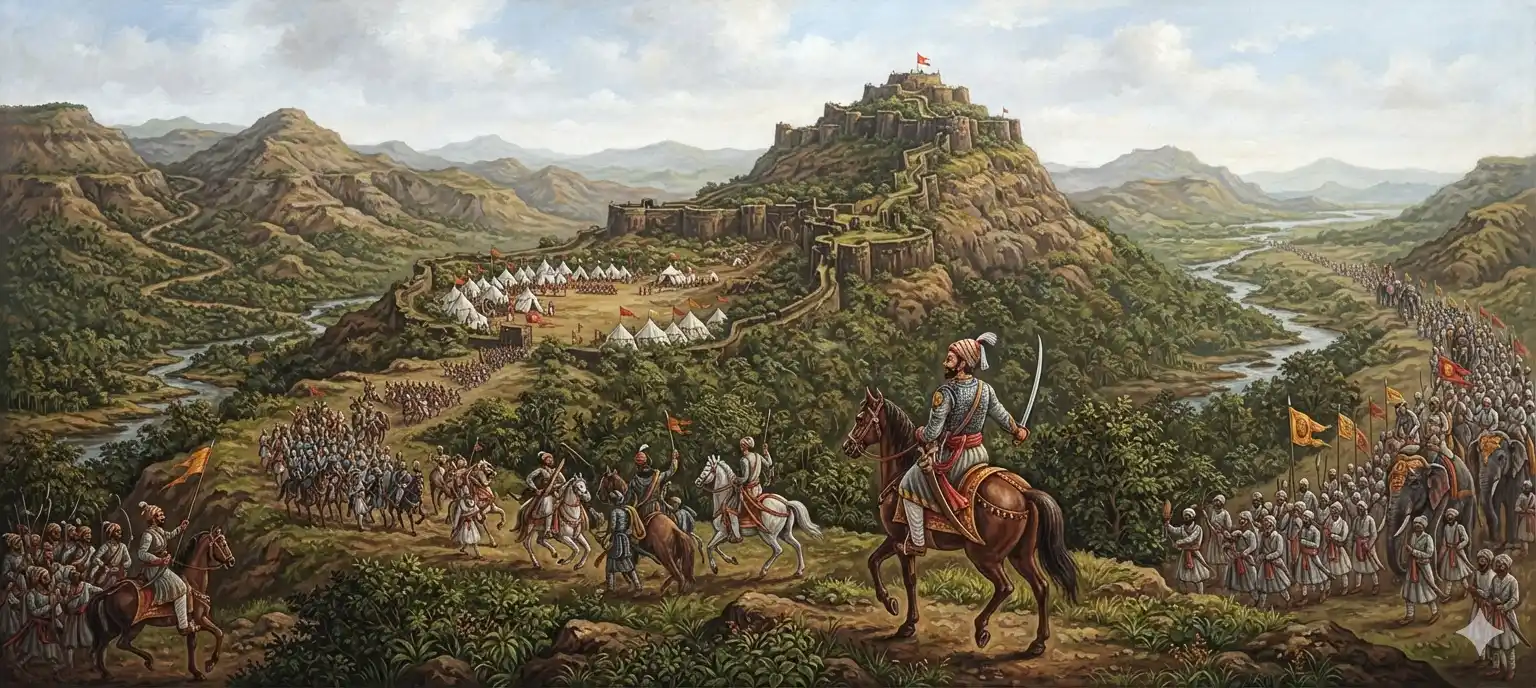
Determined to protect Raigad, Zulfiqar Khan dispatched a field force to drive Sambhaji away from Mahad before he could threaten the fort. The Mughal column, however, was intercepted and defeated by the Marathas, allowing Sambhaji to advance deeper into the region and lay siege to Raigad. For several weeks, Maratha forces tightened their grip around the fort by cutting communication routes and increasing pressure on the Mughal garrison. Sambhaji's sudden appearance before Raigad caused serious concern within the Mughal camp, as Zulfiqar Khan had not expected the Marathas to reach the capital's doorstep so quickly. The situation changed when reports arrived that Rustam Khan was marching from the Vishalgad region with his large army. Recognizing that remaining before Raigad could leave his forces trapped between the fort's garrison and Rustam Khan's advancing army, Sambhaji chose caution over unnecessary risk. Rather than fight a potentially disastrous battle against a much larger force, he ordered the siege to be lifted. The Marathas withdrew in good order toward the Mahad region before Rustam Khan could force an engagement. Although Raigad remained in Mughal hands, the campaign was far from a Mughal success. Sambhaji had demonstrated his ability to threaten the heart of Mughal power, defeat forces sent against him, and compel Rustam Khan to abandon his position near Vishalgad fort and rush across Maharashtra to save the fort. The operation exposed weaknesses in Mughal deployments and confirmed that the Marathas had regained the strategic initiative.
While Rustam Khan hurried toward Raigad to relieve the Mughal garrison there, Dhanaji Jadhav seized the opportunity he had been waiting for. With the main Mughal army withdrawn from the region, he advanced rapidly and laid siege to Vishalgad. The Mughal defenders fought stubbornly, confident that Rustam Khan would soon return with his powerful army to lift the siege. They rejected repeated calls to surrender, made repeated attacks against Maratha positions, and made every effort to hold the fort against the attackers.
Dhanaji, however, remained patient and refused to waste men in costly assaults. The fort was completely surrounded, all supply routes were cut, and every attempt by the defenders to communicate with nearby Mughal forces was intercepted. As weeks turned into months, the garrison slowly realized that no relief army was coming. Food stocks steadily dwindled, morale declined, and the condition of the defenders worsened with each passing day. Despite their determined resistance, they found themselves isolated and abandoned. With provisions nearly exhausted and all hope of rescue gone, the Mughal commander finally opened negotiations. The garrison surrendered under agreed terms, and the Maratha flag was once again raised over Vishalgad. The capture of the fort was a major strategic success. Sambhaji's deception had achieved exactly what he intended: Rustam Khan had been drawn away from Vishalgad in an attempt to save Raigad, only to lose the very fortress he had been entrusted to defend. The fall of Vishalgad restored one of the Marathas' most important strongholds and marked another significant step in the gradual recovery of territory lost during the years of Mughal domination.
When news reached Zulfiqar Khan that Sambhaji Maharaj had withdrawn from Mahad into the Varandha Ghat region, he assumed that the Marathas were retreating out of fear. Determined to destroy Sambhaji once and for all, he ordered Rustam Khan to pursue him with a powerful army of 60,000 men. Confident in his numerical superiority, Rustam Khan eagerly marched into the rugged mountain passes, believing he could force the Marathas into a decisive battle. Sambhaji, however, had no intention of fighting on Mughal terms. Instead, he carefully lured the Mughal army deeper into the difficult terrain by sending small groups of Maratha scouts and cavalry to appear briefly before withdrawing into the hills. Their movements convinced the Mughals that the Marathas were retreating in disorder, encouraging Rustam Khan to advance farther into the mountains. As the army advanced, its artillery, cavalry, infantry, baggage animals, and supply wagons stretched over many kilometers along the narrow roads and steep passes, unknowingly entering a carefully prepared trap.
Once the Mughal forces had penetrated deep into Varandha Ghat, Sambhaji put his plan into action. Maratha warriors occupied the surrounding heights and launched attacks on isolated sections of the long Mughal column. Trees were cut down across the roads, rockslides were deliberately triggered, and narrow mountain tracks were blocked, making communication between different parts of the army increasingly difficult. Commanders found it almost impossible to support one another, and the once-unified Mughal force was gradually divided into several disconnected groups scattered throughout the passes. Rather than attacking the strongest formations directly, the Marathas focused on destroying the army's supply system. Fighters repeatedly descended from the hills to strike supply caravans, baggage trains, pack animals, and ammunition wagons. Food stocks were burned, transport animals were scattered, and vital supplies were either captured or destroyed. As supplies ran low and the difficult terrain trapped the advancing army, Rustam Khan repeatedly tried to force Sambhaji into an open battle. The Maratha ruler, however, refused to abandon his strategy, avoiding a direct confrontation and steadily weakening the Mughal army through relentless attacks on its lifeline.
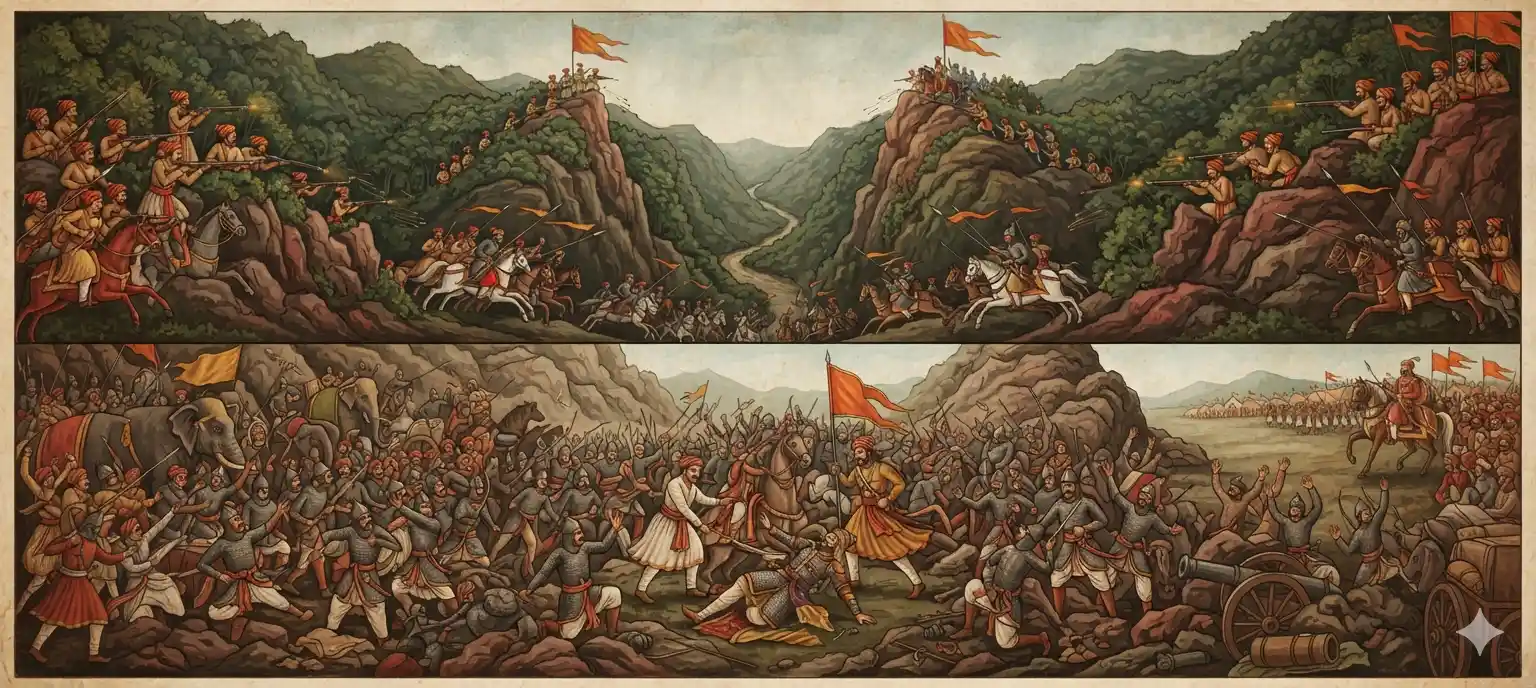
After weeks of relentless harassment, mounting exhaustion, and continuous losses, Mughal morale began to collapse. Sensing that the enemy had been sufficiently weakened, Sambhaji Maharaj launched the decisive phase of the campaign. Guided by local inhabitants who knew every hidden forest path, Maratha forces quietly moved around the Mughal positions and occupied the key exits from Varandha Ghat. Rustam Khan soon realized that both his advance and retreat routes were under threat, leaving his army surrounded by steep, hostile hills filled with thousands of Maratha warriors. Determined to break out of the encirclement, he personally led a large force against what he believed was the weakest Maratha position. The assault initially gained ground, but the move had been anticipated. As the Mughal troops entered a narrow valley, concealed Maratha warriors struck from both sides. Muskets fired from hidden positions while Maratha cavalry sealed the exits, trapping the attackers inside. A fierce battle followed in which Rustam Khan fought courageously and repeatedly tried to rally his men, but the Mughal formation collapsed under attacks from every direction. During the fighting, Rustam Khan was killed, and news of his death spread rapidly through the army, shattering what remained of Mughal morale.
Leaderless and demoralized, many Mughal units attempted to flee through the mountain passes, only to find the roads blocked and Maratha forces waiting on the surrounding heights. Others, having exhausted their food and ammunition, surrendered. The once-powerful Mughal army disintegrated as survivors abandoned artillery, equipment, baggage, and supplies in desperate attempts to escape the ghat. The Battle of Varandha Ghat became one of Sambhaji Maharaj's greatest victories. By refusing a conventional battle and making full use of the difficult terrain, he destroyed a much larger Mughal force and eliminated one of the empire's leading commanders. The victory electrified Maharashtra, encouraging many chiefs who had remained neutral to openly support the Maratha cause, while Mughal garrisons across the region grew increasingly anxious. Above all, the battle proved that even after years of defeat and exile, Sambhaji Maharaj remained fully capable of outmaneuvering and defeating the strongest armies the Mughal Empire could send against him.
Fresh from his victory at Varandha Ghat, Sambhaji Maharaj wasted no time in exploiting the shock that had spread through the Mughal ranks. Leaving the mountain passes behind, he marched through Bhor and advanced toward Pune with his army. By the time the Marathas approached the city, news of Rustam Khan's destruction and death had already reached the Mughal administration. The officials and garrison commanders stationed in Pune found themselves in a desperate situation. With the nearest major Mughal field army destroyed and no immediate reinforcements available, they feared that any attempt to resist would only bring unnecessary destruction upon the city.
As Sambhaji drew closer, panic spread through the Mughal ranks. Many soldiers deserted their posts, while others urged their commanders to negotiate rather than endure a hopeless siege. Recognizing the futility of further resistance, the local Mughal chief opened negotiations with the Marathas. Soon afterward, Pune was formally surrendered, and the Mughal garrison laid down its arms, handing control of the city to Sambhaji Maharaj without a major battle. The return of the Marathas to Pune was welcomed with celebration by many local inhabitants. After years under Mughal authority, the saffron banner once again flew over one of the most important cities in Maharashtra. The recapture of Pune marked a dramatic turning point in the campaign. Only a short time earlier, Sambhaji had been a fugitive seeking refuge in distant lands. Now he had returned to one of the principal cities of his kingdom, while Mughal authority across western Maharashtra began to show clear signs of unraveling.
Following the capture of Pune, Sambhaji Maharaj consolidated his position and began preparing for his next objective—the recovery of Raigad, the former Maratha capital that remained under Mughal control. At the same time, Dhanaji Jadhav marched north from Vishalgad through the Satara region, gathering additional Maratha forces as he advanced. After reaching Pune, he joined Sambhaji, and together they planned the campaign to recapture Raigad. The Maratha victories at Vishalgad and Pune, combined with the destruction of Rustam Khan's army, caused growing concern within the Mughal camp. Although Zulfiqar Khan still held Raigad, his position became increasingly vulnerable as Maratha-controlled territory steadily expanded around the fort.
Determined to prevent the loss of Raigad, Aurangzeb ordered Firuz Jang to march toward the fort with a large army to reinforce Zulfiqar Khan. The emperor hoped that the arrival of fresh troops would stabilize the situation and crush the revived Maratha offensive before it reached the gates of the capital. Meanwhile, Aurangzeb left Kalyan and relocated to Aurangabad, where he could more effectively coordinate imperial operations across the Deccan and maintain communication with the northern Mughal provinces. Even from there, he closely monitored developments around Raigad, fully aware that the fate of the fort would carry immense political and military significance. As Firuz Jang advanced toward Raigad and the Marathas assembled their forces at Pune, both sides prepared for what many believed would become the decisive campaign of the war.
While Firuz Jang marched from Kalyan toward Raigad through the Konkan route of Pen and Mangaon, Sambhaji Maharaj realized that the Mughal relief force would need valuable time to reach the fortress. Determined to take advantage of this opportunity, he divided his army. Dhanaji Jadhav was assigned a fast-moving force to shadow Firuz Jang's advance, launching repeated raids and ambushes along the Pen–Mangaon corridor. These attacks disrupted Mughal movement, slowed the march, and forced Firuz Jang to proceed with extreme caution. Meanwhile, Sambhaji personally led the main Maratha army directly toward Raigad. Inside the fort, Zulfiqar Khan received reports of the advancing Marathas but refused to risk an engagement outside the walls. Confident in Raigad's formidable defenses and encouraged by the knowledge that Firuz Jang was marching to his assistance, he concentrated his forces within the fortress and prepared to withstand a siege. Sambhaji, however, possessed an advantage that no Mughal commander could match. Having lived at Raigad for years, he knew the surrounding terrain and several concealed approaches known only to a handful of trusted men. Rather than settle into a lengthy siege that might allow Firuz Jang to arrive, he decided to strike immediately.
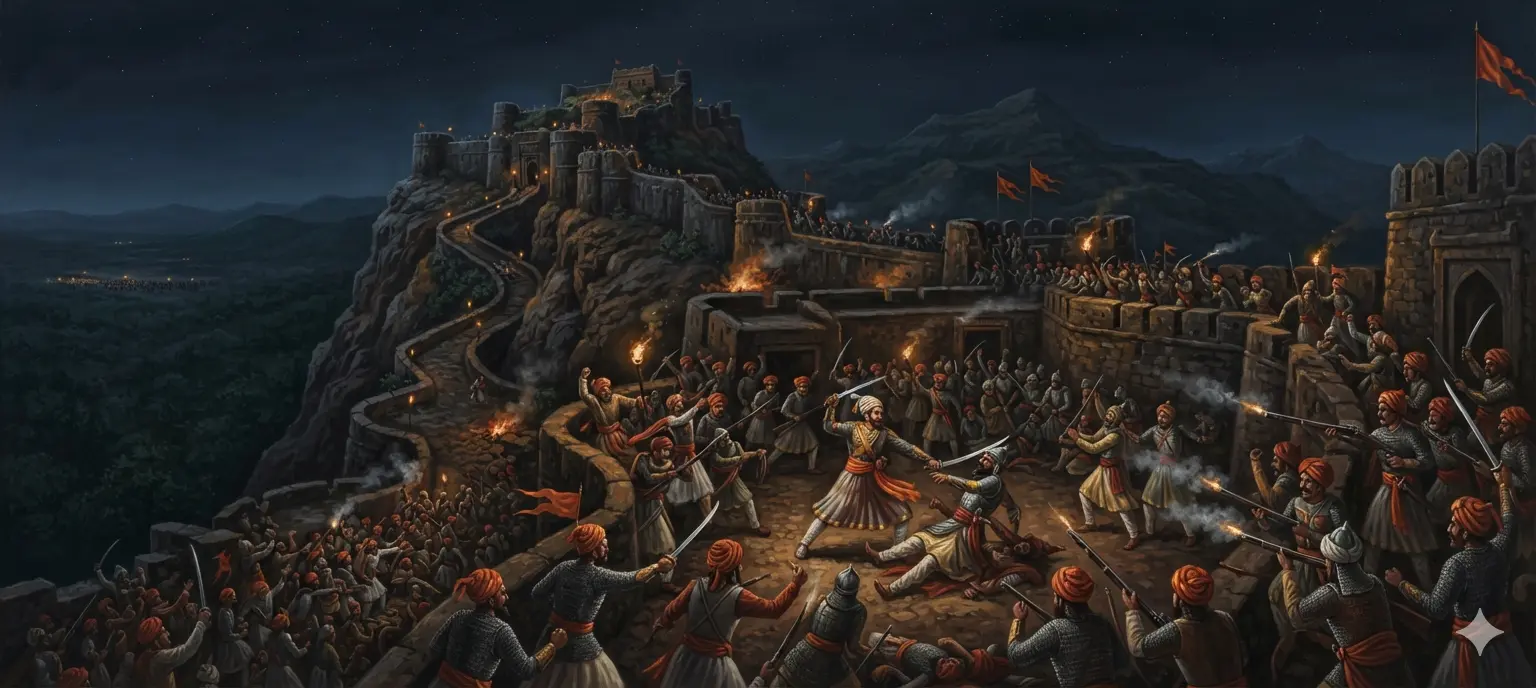
On a moonless night, a carefully selected force of experienced Maratha veterans silently climbed one of the hidden approaches to the fortress. Reaching the summit without detection, they secured key entry points and opened the way for additional Maratha troops. Before the Mughal garrison fully realized what was happening, fierce fighting erupted inside Raigad itself. Maratha and Mughal soldiers clashed through narrow passages, courtyards, gateways, and vital defensive positions as the surprised defenders struggled to organize an effective resistance. As the battle intensified, Sambhaji personally led assaults against the strongest Mughal positions, while Zulfiqar Khan entered the fighting in an effort to rally his men and restore order. Amid the confusion of the night battle, the two commanders finally confronted each other. A fierce duel followed, and after a hard-fought struggle, Sambhaji struck down Zulfiqar Khan. News of the commander's death spread rapidly through the Mughal ranks, destroying what remained of their resistance. Leaderless and surrounded, many defenders surrendered, while others attempted to flee. By dawn, the Marathas had secured complete control of Raigad. The recapture of the fortress marked the greatest triumph of Sambhaji's restoration campaign. The stronghold that had once symbolized the fall of Maratha power was once again under Maratha control, while the death of Zulfiqar Khan deprived the Mughal Empire of one of its most capable commanders and dealt a severe blow to Mughal prestige throughout the Deccan. When Firuz Jang finally approached the region, he learned that Raigad had already fallen and that Zulfiqar Khan had been killed. What had begun as a mission to save the fortress had instead ended with one of the most dramatic Maratha victories of the war.
The triumph at Raigad was soon overshadowed by troubling news from the north. Sambhaji Maharaj learned that Dhanaji Jadhav's mission to delay Firuz Jang had ultimately failed. Despite repeated Maratha raids and attempts to disrupt his advance, Firuz Jang maintained strict discipline within his army and refused to be lured into traps. His forces continued their march with little delay, and during one of the Maratha attacks, Dhanaji was surrounded and captured. Recognizing the importance of his prisoner, Firuz Jang ordered the execution of the renowned Maratha commander, depriving Sambhaji of one of his most trusted and capable generals at a crucial stage of the campaign.
The situation became even more alarming when fresh reports arrived from the Konkan. Firuz Jang had crossed the Pen region, reached Mangaon, and his large army now stood only a short distance from Raigad. Inside the recently recaptured fortress, celebrations quickly gave way to urgent military preparations. Although the Marathas had regained Raigad and eliminated Zulfiqar Khan, the fort had only just returned to their control. Its garrison was still being reorganized, parts of its defenses had been damaged during the fighting, and supplies had not yet been fully replenished. Sambhaji now faced a difficult decision. He could remain within Raigad and prepare to withstand a siege by Firuz Jang's advancing army, or he could leave the safety of the fortress and confront the Mughals before they reached its walls. Both choices carried serious risks. What had appeared to be a decisive victory only days earlier was rapidly becoming another critical test, as Firuz Jang advanced toward Raigad and the future of the Maratha capital once again hung in the balance.
With Raigad restored to Maratha control and Firuz Jang advancing from Mangaon with a powerful army, Sambhaji Maharaj realized that another major confrontation was unavoidable. The loss of Dhanaji Jadhav had weakened the Maratha leadership, and a direct battle against a fresh Mughal force carried significant risks. Rather than fight on unfavorable terms, Sambhaji turned to deception. He sent a message to Firuz Jang claiming that years of warfare had exhausted the Marathas and that he was prepared to acknowledge Aurangzeb's supremacy, pay tribute, and negotiate peace. As a sign of goodwill, he proposed a personal meeting near Raigad, with only a small escort accompanying each side. The offer surprised Firuz Jang. Although the recent fall of Raigad and the death of Zulfiqar Khan had proved that Sambhaji remained a dangerous opponent, the prospect of securing the Maratha ruler's submission without another costly campaign was too tempting to dismiss. After brief negotiations, he agreed to the meeting.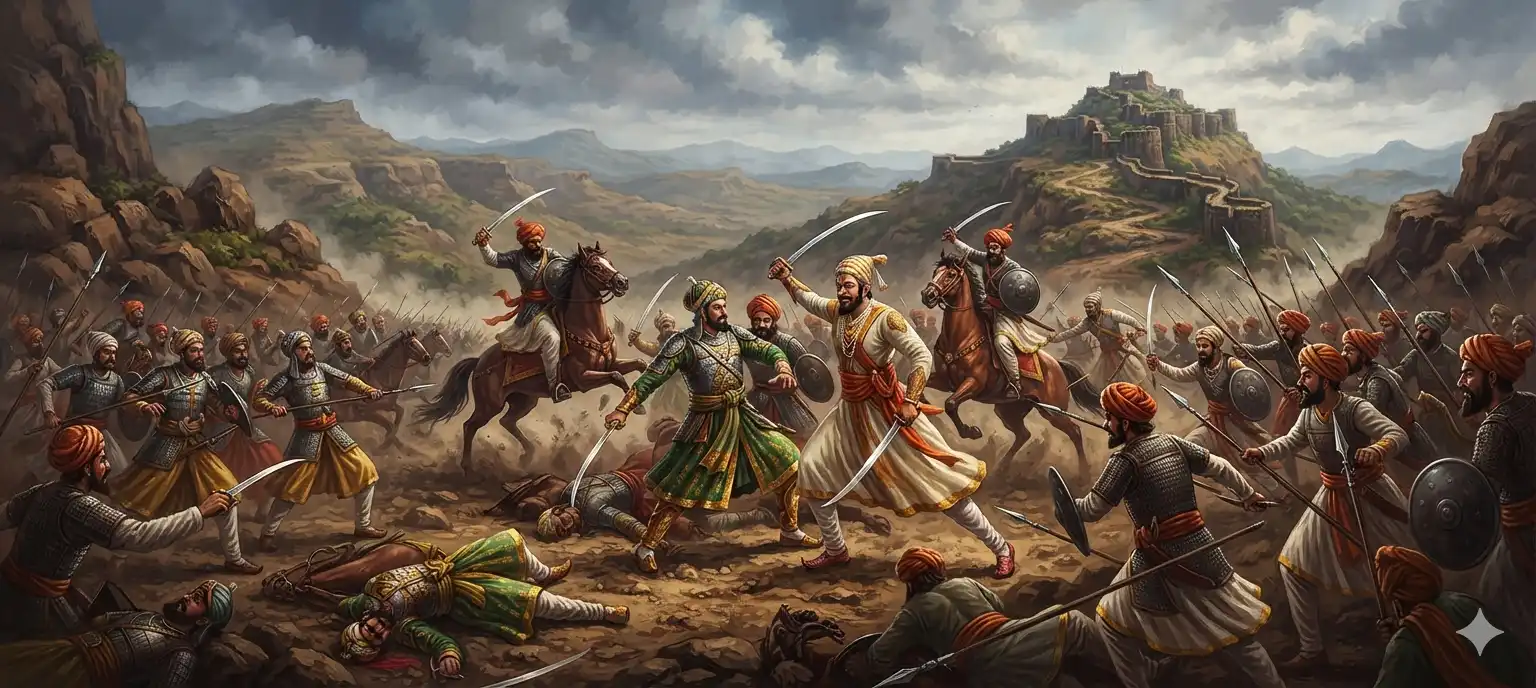
On the appointed day, both leaders arrived with only a limited number of visible attendants. The atmosphere remained tense but appeared peaceful as discussions began, and Firuz Jang believed he was witnessing the conclusion of the long conflict. Unknown to him, Sambhaji had secretly positioned selected Maratha warriors in the surrounding terrain, waiting for a predetermined signal. As the meeting progressed, the signal was given, and hidden Maratha troops suddenly emerged, charging toward the Mughal escort. Caught completely by surprise, the Mughals struggled to organize a defense as confusion spread through their ranks. In the midst of the fighting, Sambhaji and Firuz Jang found themselves at the center of the clash. A fierce close-quarters battle followed, and although Firuz Jang fought to resist, he was isolated from his main army and overwhelmed before reinforcements could arrive. His death threw the nearby Mughal forces into confusion. Deprived of their commander and uncertain about the situation, many units withdrew to regroup while the Marathas secured the area. Within a short period, the deaths of both Zulfiqar Khan and Firuz Jang dealt a devastating blow to Mughal authority in western Maharashtra. What had begun as an attempt to force Sambhaji into submission instead ended with the loss of another senior Mughal commander and a major boost to Maratha morale.
The death of Firuz Jang threw the Mughal forces into confusion. Already shaken by the loss of Zulfiqar Khan, many Mughal units withdrew from the Raigad region or dispersed without coordinated resistance. Sambhaji Maharaj acted swiftly, securing Raigad, repairing its defenses, and placing a strong Maratha garrison within the fort. His forces then advanced into the surrounding districts and occupied Panvel, strengthening Maratha control over the important routes linking the Konkan with the Deccan. In only a few years, Sambhaji had transformed from a fugitive sheltered by Queen Chennamma into the ruler of a revived Maratha state centered once again on Raigad. The series of Mughal defeats deeply alarmed Aurangzeb. With western Maharashtra slipping from imperial control and two of his leading commanders dead, he abandoned Aurangabad and withdrew to Ahmednagar. Continuing his campaign, Sambhaji captured Kalyan, further strengthening Maratha control over the approaches between the Konkan and the Deccan. Although several commanders urged him to push deeper into Mughal territory toward Ahmednagar, Sambhaji chose restraint. He recognized that the Mughals still possessed strong armies, experienced commanders, and secure supply bases across the northern Deccan. Rather than overextend his forces, he focused on consolidating his recent gains by strengthening the defenses of Raigad, Pune, Kalyan, Vishalgad, and Panhala. This cautious strategy reflected how dramatically Maratha fortunes had changed.
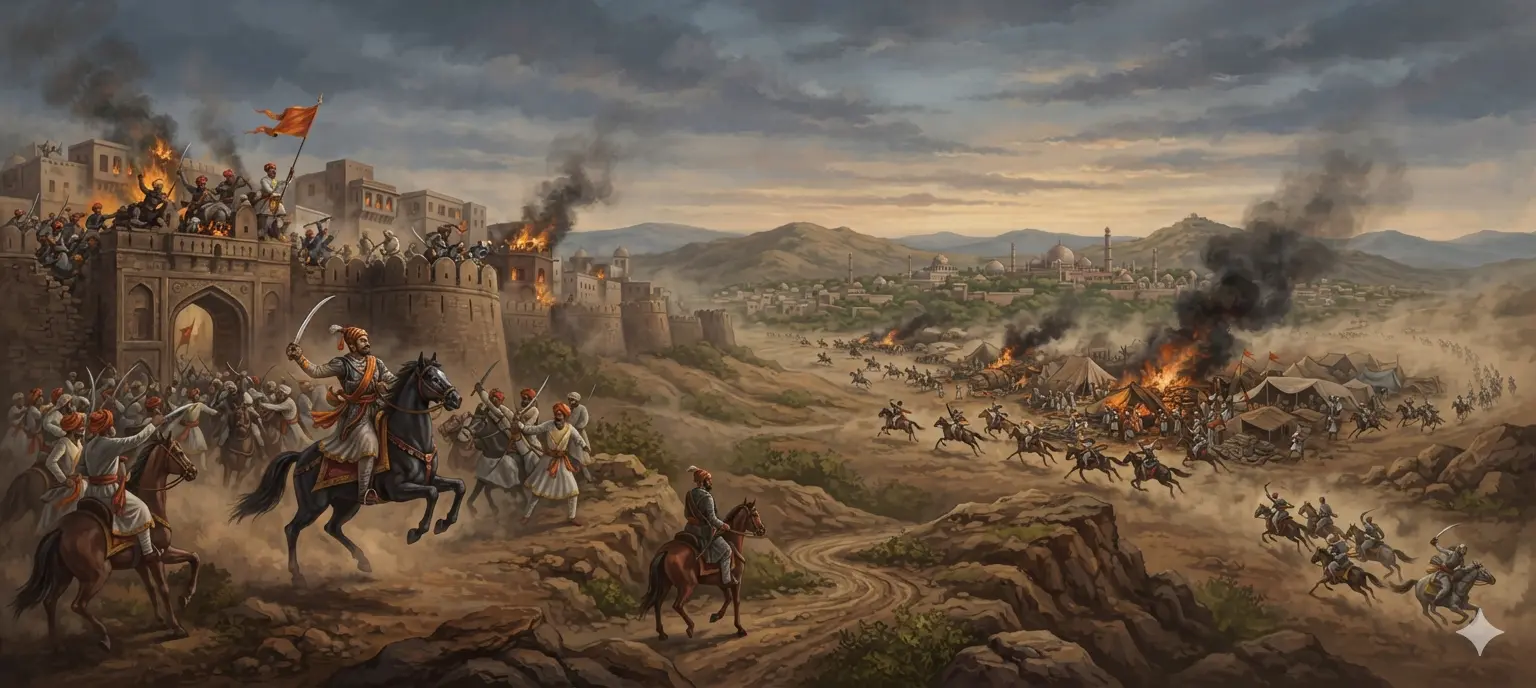
Continuing to maintain the initiative, Sambhaji Maharaj shifted his attention toward the northern Deccan, recognizing the importance of controlling key movement corridors and disrupting Mughal coordination. He launched a swift offensive against Nashik, where the Mughal defenses, already weakened by repeated setbacks across Maharashtra, were unable to withstand the speed and coordination of the Maratha advance. The city quickly fell into Maratha hands, strengthening Sambhaji's influence over the northern approaches to the Deccan. Rather than overextending his army by occupying territory deep inside Mughal lands, Sambhaji adopted a more flexible strategy and dispatched a separate raiding force toward Aurangabad. Their objective was not conquest but the destruction of Mughal supply centers, administrative posts, and communication routes.
The raid achieved its purpose with remarkable speed. Maratha forces struck key Mughal positions around Aurangabad, creating confusion and panic before withdrawing swiftly, denying the Mughals any opportunity to organize an effective counterattack. The operation had an impact far beyond the immediate damage, as reports reaching the Mughal court described a highly mobile Maratha army capable of penetrating secure imperial territory and disappearing before a response could be mounted. Confronted with growing instability and unable to guarantee the security of even the rear areas of his Deccan administration, Aurangzeb abandoned his position at Ahmednagar and shifted his headquarters farther north to Burhanpur, seeking a safer and more stable base for imperial operations.
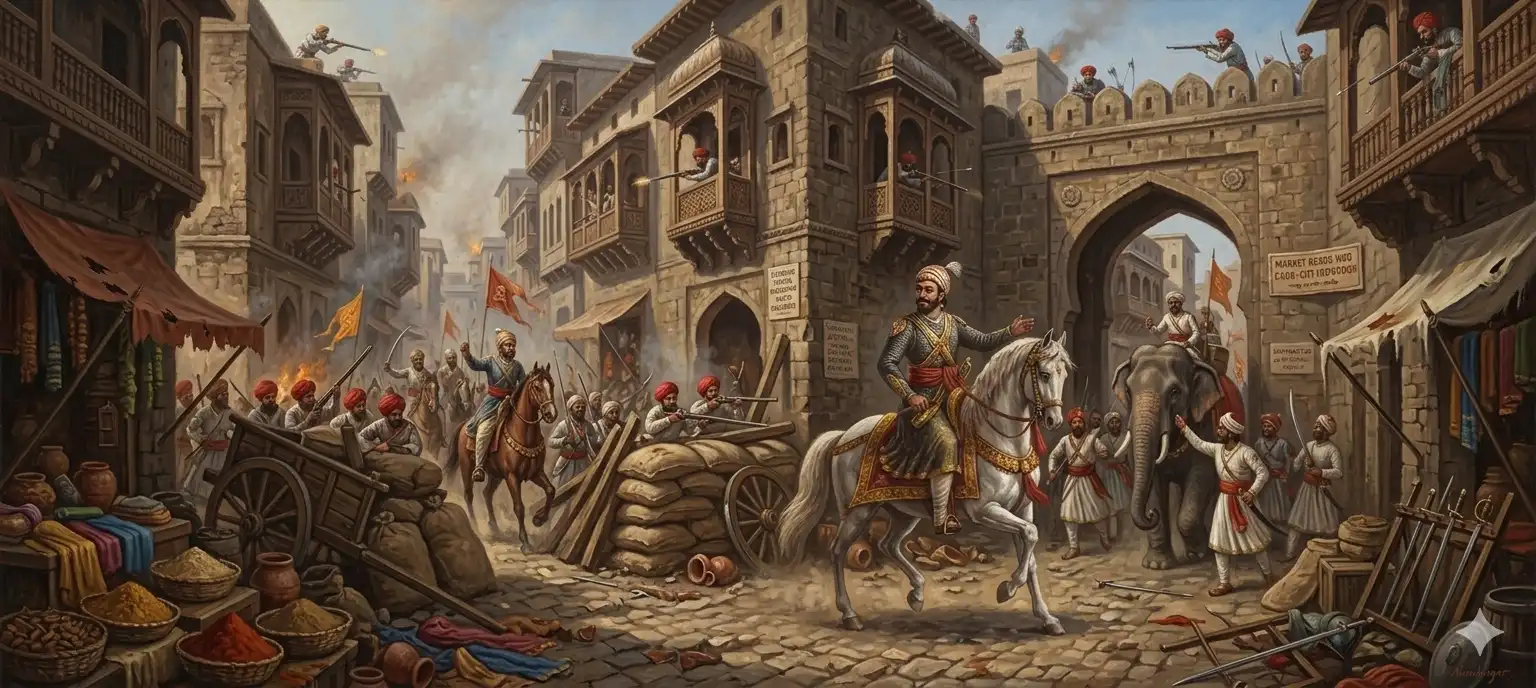
Fresh from his victory in Nashik, Sambhaji Maharaj turned his attention toward Ahmednagar, hoping that the recent defeat of its commander had weakened the city's defenses and shaken the morale of its remaining garrison. Advancing south with confidence, he soon discovered that the situation was very different from what the Marathas had anticipated. Although the field army had been destroyed, Ahmednagar still possessed a strong Mughal garrison. Its commanders had reinforced the fortifications, accumulated ample supplies, and prepared for a siege after receiving reports of Maratha victories across the Deccan. The city's defenses remained intact, and the defenders showed no willingness to surrender. Sambhaji launched a series of attacks against the outer defenses in an effort to identify weak points and force the garrison into panic, but the Mughal troops resisted stubbornly and successfully repelled every assault. Attempts to lure them into open battle also failed, as the commanders refused to leave the safety of their fortifications.
After several days of fighting and careful reconnaissance, Sambhaji concluded that Ahmednagar remained a formidable stronghold requiring a prolonged siege and resources that the Marathas could not afford to commit. Continuing the operation would only allow the Mughals time to bring reinforcements from Aurangabad and Burhanpur. Choosing practicality over unnecessary losses, he ordered the army to withdraw before a relief force could arrive. Although the attack failed to capture the city, the campaign still achieved important results. Sambhaji had demonstrated that even one of the strongest Mughal positions in Maharashtra was no longer beyond the reach of the Maratha army. The operation also forced the defenders to remain on constant alert and prevented them from diverting troops to other fronts. For the Mughals, Ahmednagar had been successfully defended, but for Sambhaji, the withdrawal represented only a temporary setback in a campaign that continued to keep the strategic initiative firmly in Maratha hands.
The failed attack on Ahmednagar did little to change the overall course of the campaign, as Maratha victories across Maharashtra had already weakened Mughal authority. Several imperial commanders suffered defeats, while growing Maratha control over the countryside restricted Mughal influence beyond a few fortified cities. From Burhanpur, Aurangzeb received reports of the worsening situation and realized that holding Maharashtra was becoming increasingly difficult. The Marathas moved freely across the province, preventing the Mughals from regaining the initiative. At the same time, Aurangzeb grew concerned about protecting the empire's northern territories and the vital routes linking the Deccan with the Mughal heartland. Continuing the campaign demanded heavy resources with little hope of decisive success.
After careful consideration, Aurangzeb ordered a strategic withdrawal from the remaining Mughal positions in Maharashtra. Garrisons at Ahmednagar, Aurangabad, and other surviving strongholds were instructed to evacuate and retreat toward Burhanpur and the northern frontier. The withdrawal ended a long and costly struggle, with Mughal troops abandoning their posts one after another. In many areas, local people welcomed their departure, while Maratha forces quickly took control. As the last Mughal columns left Maharashtra, Sambhaji Maharaj restored his authority across the province, and key cities like Ahmednagar and Aurangabad passed into Maratha hands without prolonged sieges. For Sambhaji, it marked the reward for years of struggle and resilience, while for Aurangzeb, it was a reluctant acceptance that Maharashtra could no longer be held by force, leaving the initiative firmly with the Marathas.
With Mughal authority in Maharashtra broken and the western Deccan firmly under Maratha control, Sambhaji Maharaj turned his attention toward the Portuguese possessions along the Konkan coast. Goa remained the largest European enclave in western India and controlled several important ports that influenced trade, diplomacy, and maritime activity. Bringing Portuguese power under pressure would not only secure the Maratha coastline but also strengthen Sambhaji's position as the dominant ruler of western India.
Before beginning the campaign, Sambhaji carefully prepared the diplomatic and military groundwork. He secured alliances with most of the non-Portuguese rulers surrounding Goa, ensuring that the Portuguese would receive little assistance from their neighbors. Once these arrangements were complete, a large Maratha army of nearly 50,000 troops was assembled at Belagavi and marched southwest toward Goa. Guided by local allies and supported by an efficient supply network, the army advanced rapidly through the interior. The Portuguese were alarmed by reports of the massive Maratha mobilization but remained uncertain of its exact objective. The Marathas soon entered the Goan hinterland and reached Bicholim, bringing Sambhaji's army to the doorstep of Portuguese Goa.
From Bicholim, Sambhaji Maharaj advanced toward Mapusa. A small Portuguese force attempted to block the Maratha advance, but it was quickly overwhelmed by the superior numbers and momentum of Sambhaji's army. After a brief resistance, the Portuguese defenders withdrew, allowing the Marathas to capture Mapusa and establish control over the northern approaches to Portuguese Goa.
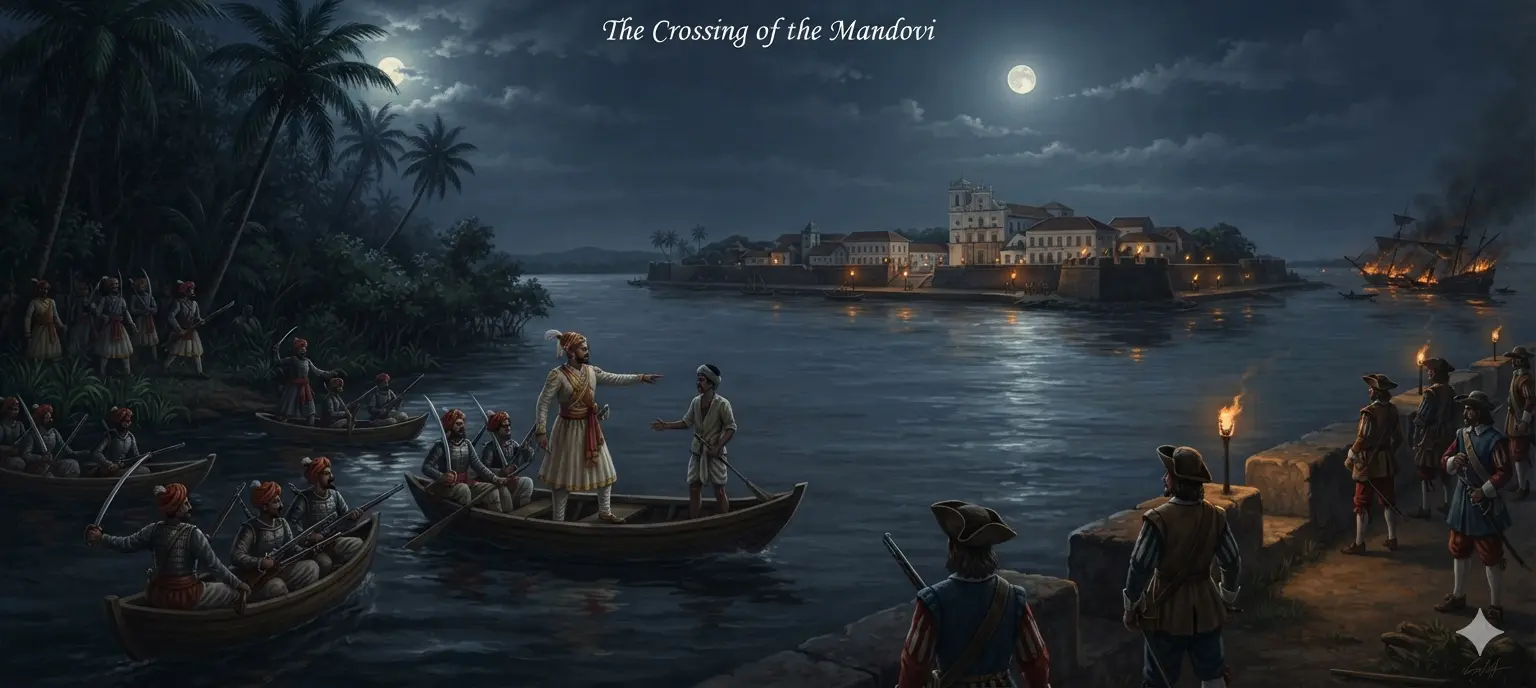
The Portuguese had heavily fortified the crossings of the Mandovi River, expecting the Marathas to attempt a direct advance toward Panjim. At the same time, a Maratha fleet sailing from the Konkan coast towards the Mandovi delta was intercepted by the Portuguese navy and largely destroyed in the Arabian Sea, seemingly securing the river approaches. Sambhaji Maharaj, however, refused to abandon the campaign. With the assistance of local fishermen familiar with the waterways, he secretly identified a less-guarded crossing near Betim. Under the cover of darkness, selected Maratha troops were ferried across the Mandovi in small groups, avoiding the heavily defended crossings watched by the Portuguese.
By the time the Portuguese realized what had happened, Maratha forces had already established themselves on the opposite bank. The garrison at Panjim, expecting an attack from the front and believing the river to be secure, was caught completely off guard. Sambhaji swiftly launched his assault, and after a fierce but brief struggle, the surprised Portuguese defenders were routed, allowing the Marathas to seize Panjim and gain a foothold in the heart of Portuguese Goa.
Following the capture of Panjim, Sambhaji Maharaj advanced against Old Goa, the heart of Portuguese power in the region. The Portuguese authorities, along with many soldiers and officials, withdrew behind the city's fortified positions and sought refuge in its heavily defended churches, convents, and administrative buildings. Rather than launching an immediate assault, Sambhaji surrounded the city and cut off all supply routes. Maratha forces occupied the roads, river crossings, and nearby settlements, preventing food and reinforcements from reaching the defenders. Artillery bombarded key defensive positions while Maratha patrols ensured that no one could escape the encirclement. As the siege continued, shortages of food and ammunition weakened the Portuguese defenders. Repeated attempts to break through the Maratha lines failed, and hopes of relief by sea steadily faded as the Marathas tightened their grip on the surrounding countryside. Realizing that further resistance would only bring greater losses, the Portuguese leadership opened negotiations. Sambhaji offered safe passage by sea in exchange for the surrender of the city and its remaining strongholds. With no realistic chance of victory, the Portuguese accepted the terms, surrendered Old Goa, and departed. Maratha banners were soon raised over the city, marking the end of Portuguese rule in the region and completing Sambhaji Maharaj's conquest of Goa.
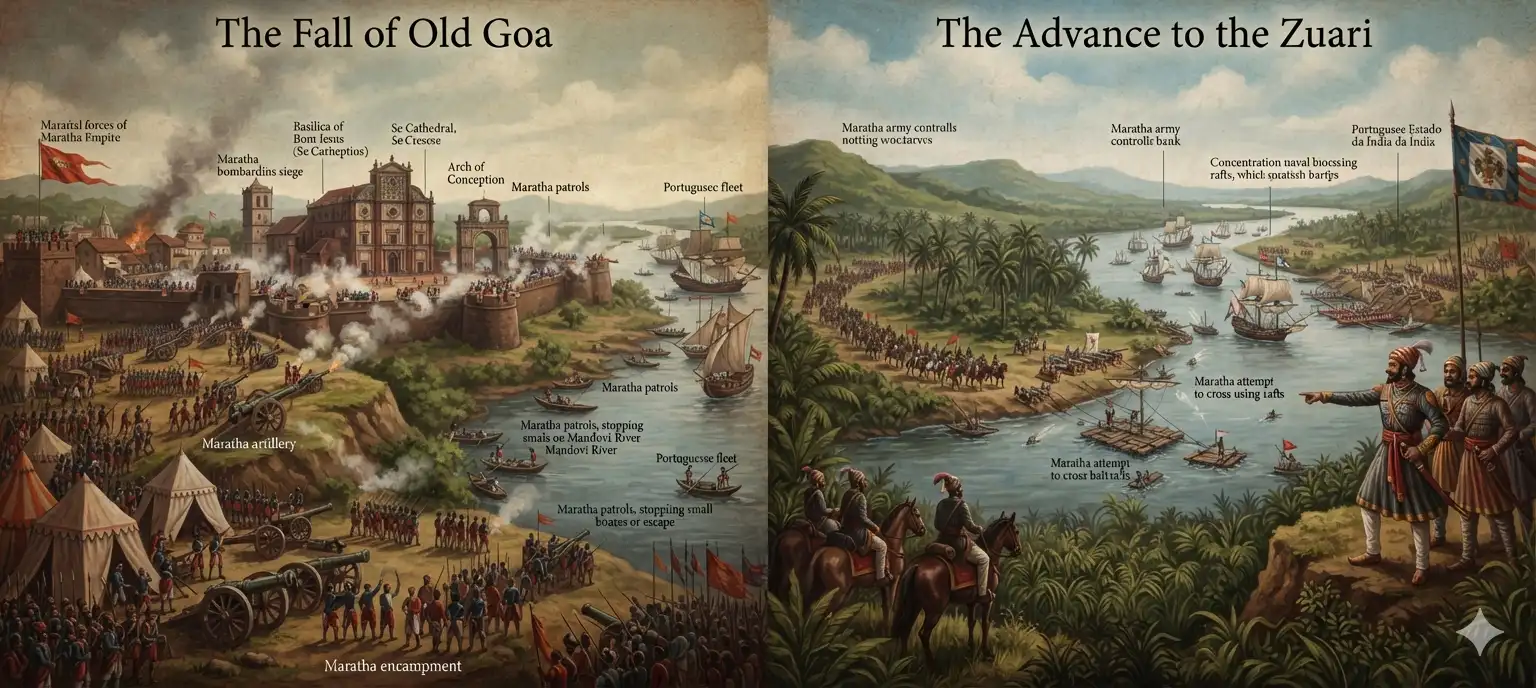
After securing Old Goa, Sambhaji Maharaj continued his advance southward. Maratha forces rapidly occupied the surrounding territories and extended their control up to the banks of the Zuari River. Several smaller Portuguese positions were abandoned or surrendered as news of Old Goa's fall spread across the region. However, the Maratha advance met a serious obstacle at the Zuari. Unlike the Mandovi, where Sambhaji had achieved surprise, the Portuguese were now fully prepared and had concentrated a strong naval presence on the river. Warships and armed boats patrolled the waterways, while river crossings were heavily guarded and supported by artillery along the banks. Repeated attempts by Maratha scouts to identify a suitable crossing proved unsuccessful, as any large-scale movement risked direct attack from Portuguese naval forces. Recognizing the difficulty of forcing a crossing against a prepared enemy with naval superiority, Sambhaji temporarily halted further advances. By this stage, however, the Marathas already controlled much of northern Goa and the former Portuguese heartland around Old Goa. Although the Zuari remained a formidable barrier, the campaign had greatly reduced Portuguese influence in the region and placed their remaining territories south of the river under increasing pressure.
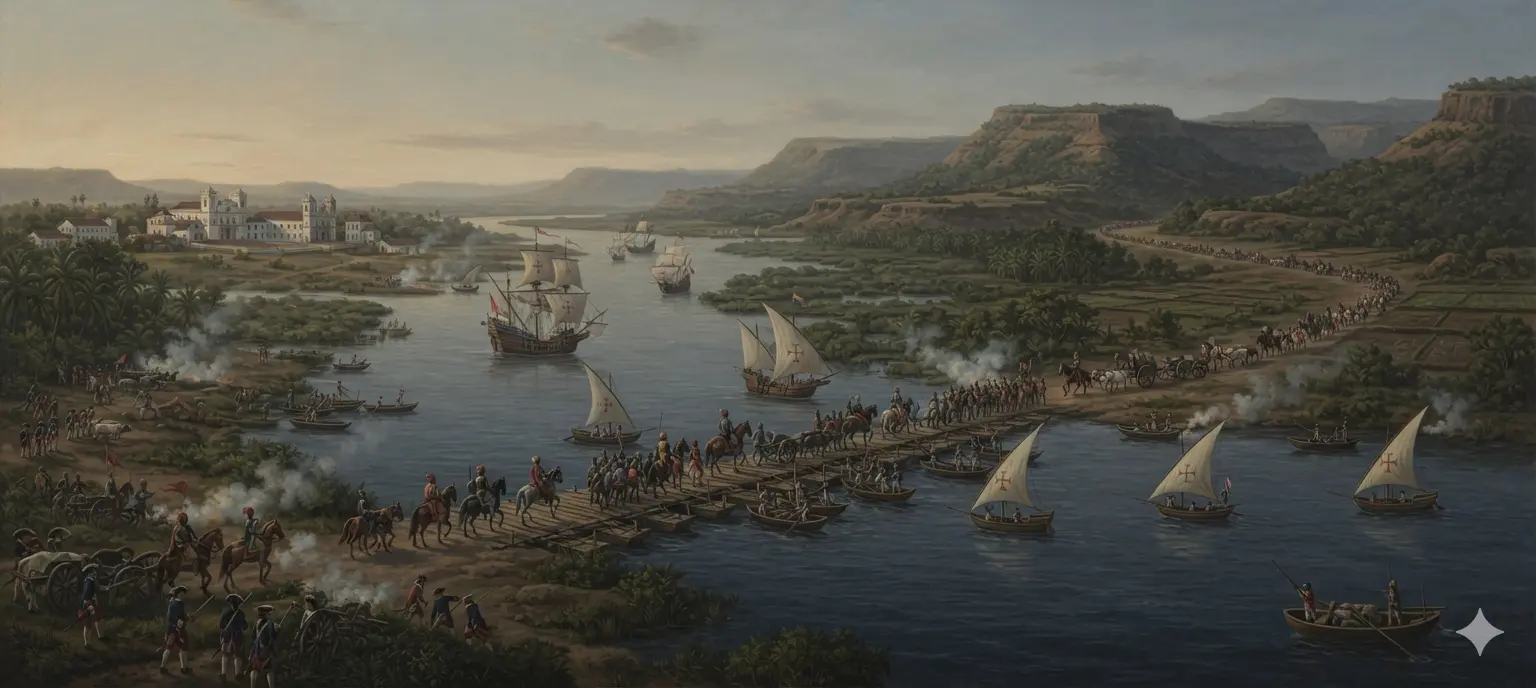
Despite the spectacular capture of Panjim and Old Goa, Sambhaji Maharaj soon found himself facing a challenge for which his army was not prepared. The Portuguese recovered from their initial shock and began a determined counteroffensive. Using their superiority at sea, they launched a series of rapid attacks along the coast and river systems, striking Maratha positions and then withdrawing aboard their ships before a decisive response could be organized. Gradually, the Portuguese regained much of the territory between the Zuari River and Old Goa. Their naval forces dominated both the Mandovi and Zuari rivers, allowing them to move troops and supplies quickly while restricting Maratha movements. The situation became increasingly dangerous as Portuguese commanders sought to trap the Maratha army around Panjim by controlling the waterways on either side.
Sambhaji carefully assessed the situation and reached a difficult conclusion. While his land forces had repeatedly defeated powerful enemies, they could not overcome a maritime power that controlled the rivers and the sea. The Maratha navy, though capable along parts of the Konkan coast, was not strong enough to challenge the Portuguese fleet in open waters or break their control of Goa's river network. Determined to avoid encirclement, Sambhaji abandoned Panjim and withdrew his army inland toward Ponda. With the assistance of a local Indian chief loyal to the Marathas, he secured safe passage through the interior and crossed back into Maratha territory before the Portuguese could cut off his retreat. The campaign ended in disappointment. Although Sambhaji had briefly occupied the heart of Portuguese Goa and demonstrated the reach of Maratha power, he had been unable to hold his gains against an enemy whose strength rested on naval supremacy. Most of the conquered territory was lost during the withdrawal, and the campaign became one of the greatest setbacks of his military career. It served as a harsh reminder that success on land alone was not always enough to secure victory against a power that ruled the sea.
As Sambhaji Maharaj recovered from the setback in Goa, major events unfolded in the Mughal Empire. Aurangzeb, whose long campaign against the Marathas had dominated the Deccan for decades, passed away. His death plunged the empire into uncertainty as his sons began competing for the imperial throne. The struggle for succession drew Mughal attention away from the Deccan. Governors and military commanders who would normally have focused on defending frontier territories now found themselves choosing sides in the conflict or waiting to see who would emerge victorious. Communication between distant provinces weakened, and imperial authority became increasingly uncertain. Sambhaji immediately recognized the significance of the moment. For years, the Marathas had been forced to fight a powerful and united Mughal Empire. Now, for the first time, that empire was distracted by internal conflict, and vast territories that had once been protected by imperial armies suddenly appeared vulnerable.
Seeing a rare opportunity, Sambhaji began preparing for fresh campaigns beyond Maharashtra. Rather than waiting for the Mughal princes to settle their dispute and restore order, he intended to exploit the confusion while it lasted. Troops were reorganized, supplies accumulated, and trusted commanders were assigned new responsibilities. The death of Aurangzeb marked the end of one era. For Sambhaji Maharaj, it signaled the beginning of another campaign in which the Marathas would no longer fight merely to defend their homeland, but could begin expanding their influence into territories that had once seemed beyond their reach.
Determined to exploit the chaos following Aurangzeb's death, Sambhaji Maharaj launched a swift campaign toward Burhanpur, the city that had served as the emperor's headquarters during the final years of the Deccan struggle. With the Mughal princes locked in a succession dispute, no major imperial army was available to defend the region. Moving rapidly across Khandesh, the Maratha forces reached Burhanpur before the local authorities could organize an effective defense. The weakened garrison, reduced by troop withdrawals and imperial uncertainty, failed to resist the assault. After entering the city, the Marathas seized imperial warehouses, treasuries, military stores, and administrative offices. Vast quantities of wealth were confiscated, government records destroyed, imperial symbols removed, and Mughal authority within the city was effectively erased.
For several days, Maratha troops systematically stripped the former imperial center of its resources before withdrawing with their spoils. Sambhaji had no intention of holding Burhanpur permanently; his objective was to demonstrate that even the city once regarded as Aurangzeb's secure refuge was no longer beyond Maratha reach. News of the city's fall and plundering spread rapidly across northern India, symbolizing the dramatic reversal of fortunes since the darkest days of the Maratha struggle. The city that had once sheltered an emperor fleeing Maratha advances had now fallen before the armies of the ruler he had sought to destroy.
Determined to increase pressure on the weakening Mughal Empire, Sambhaji Maharaj turned his attention toward Surat. Maratha naval squadrons began intercepting merchant vessels sailing to and from the prosperous port, disrupting trade and spreading uncertainty among merchants and officials alike. As commercial activity declined, concern grew within the city. Sambhaji then launched another swift raid against Surat. Maratha forces entered the city, seized large quantities of wealth, and demonstrated once again that the Mughals could no longer guarantee its security. Having made his point, Sambhaji refrained from attempting a permanent occupation. Instead, he presented the Mughal chief of Surat with a choice. Surat could either continue to face devastating Maratha raids whenever the opportunity arose, or it could accept Maratha protection and pay an annual tribute in return for peace and the security of its trade.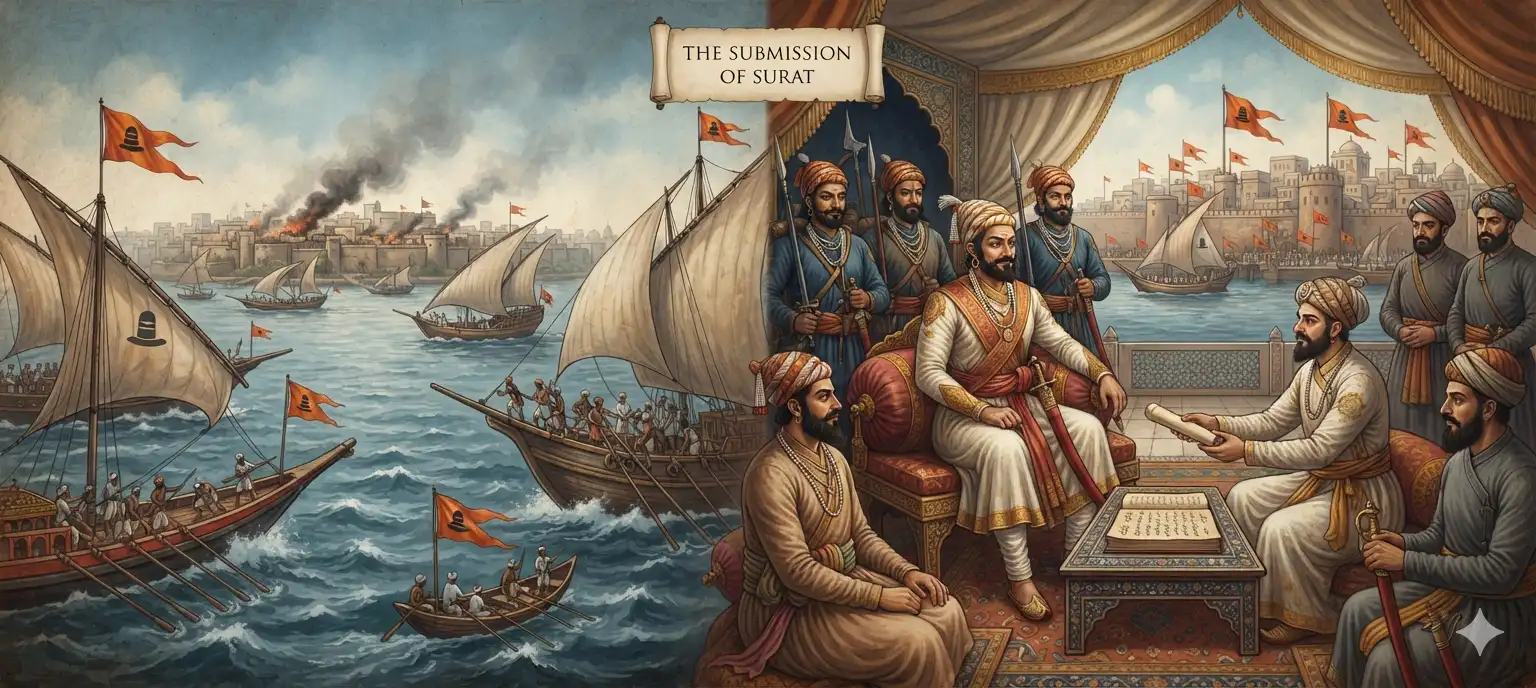
The chief found himself in a difficult position. The Mughal Empire was consumed by internal struggles, and no major relief force was expected in the near future. Faced with the prospect of repeated attacks and economic ruin, he reluctantly accepted Sambhaji's terms. An agreement was concluded under which Surat would pay a substantial annual tribute to the Marathas while continuing to govern its own affairs. In return, Sambhaji pledged to protect the city's trade from disruption by Maratha forces. The arrangement brought stability to the region and significantly increased Maratha influence along the western coast. The agreement was viewed across India as another sign of the shifting balance of power. A city that had once symbolized Mughal wealth and authority now acknowledged the supremacy of the Marathas, further enhancing Sambhaji Maharaj's prestige and strengthening the financial foundations of his expanding state.
Encouraged by his success at Surat, Sambhaji Maharaj sent envoys to Bharuch with a proposal similar to the one accepted by Surat. The city's chief was offered the opportunity to retain his position and continue administering the city in exchange for recognizing Maratha supremacy, paying annual tribute, and accepting Maratha protection. Confident in Bharuch's strength, the chief initially rejected the proposal. However, reports soon arrived that Sambhaji himself was marching north from Surat with a large army. The speed of the Maratha advance and the recent fate of other Mughal-held cities alarmed the city's officials and merchants. Realizing that no immediate Mughal assistance was likely to arrive, the chief chose negotiation over conflict and accepted Sambhaji's terms. Bharuch thus acknowledged Maratha supremacy while retaining its local administration, paying annual tribute, and operating under Maratha protection. Its peaceful submission strengthened Sambhaji's influence in Gujarat and showed that the approach of a Maratha army could often achieve what once required a costly campaign.
The growing Maratha influence in Gujarat alarmed the Mughal Governor at Ahmedabad. Although the chiefs of Surat and Bharuch had accepted Maratha protection and tribute arrangements, the governor viewed these agreements as a direct challenge to Mughal authority. Determined to restore imperial control, he rejected the arrangements, removed the existing chiefs of Surat and Bharuch, and replaced them with officials loyal to the Mughal Empire. The new chiefs immediately renounced their agreements with Sambhaji, halted tribute payments, and reaffirmed Mughal allegiance. Messages were sent across Gujarat declaring that Mughal authority remained intact and that no city could make independent agreements with a foreign power. These actions sharply increased tensions between the Marathas and the Mughal administration. While the governor believed resistance was necessary to prevent further defections, Sambhaji regarded the refusal to honor the agreements as a direct challenge to his authority. Both sides understood that the dispute over Surat and Bharuch would likely determine whether Gujarat remained under effective Mughal control or gradually entered the Maratha sphere of influence.
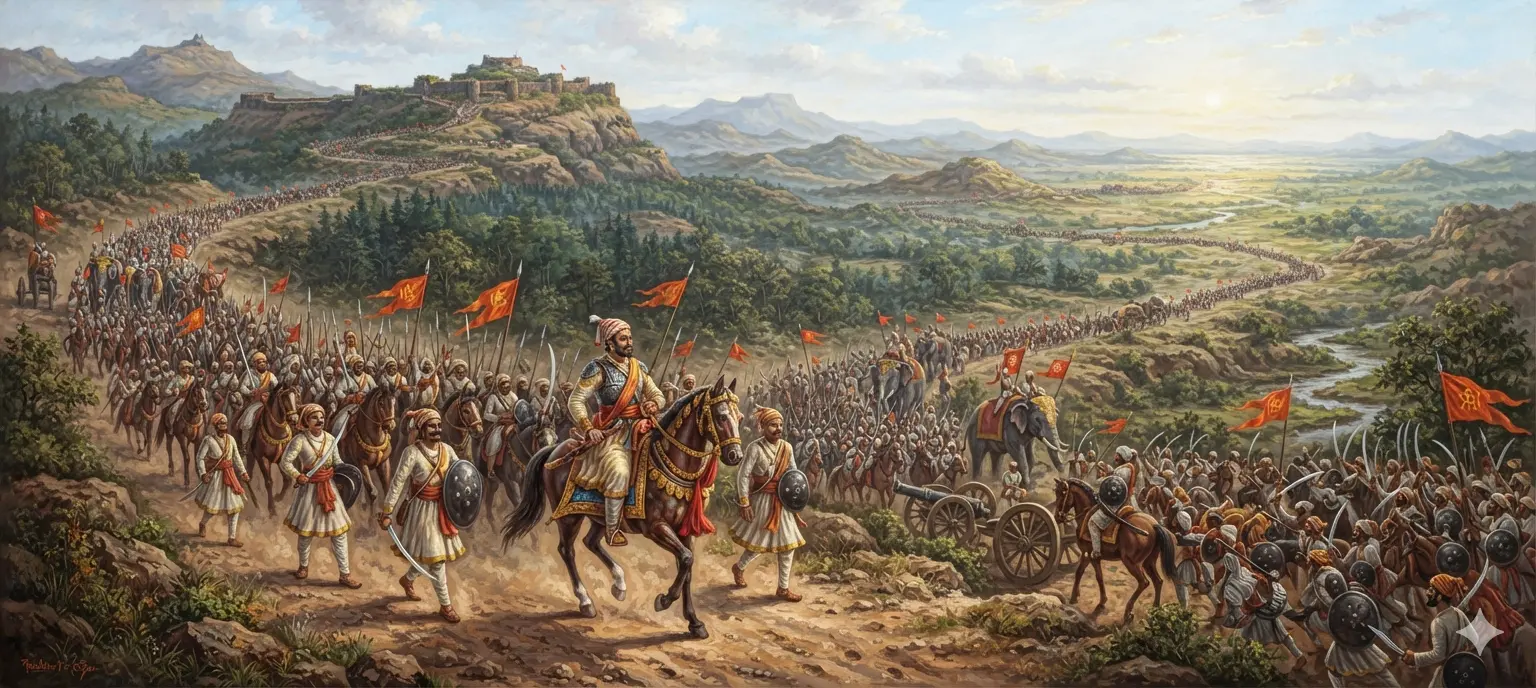 The refusal of the Mughal Governor of Gujarat to recognize Maratha authority convinced Sambhaji Maharaj that the issue could no longer be settled through diplomacy alone. As long as the governor remained powerful in Ahmedabad, the lesser chiefs of Gujarat would continue to look toward the Mughal administration rather than the Marathas for leadership and protection. Determined to resolve the matter decisively, Sambhaji used the wealth acquired from the raids on Surat and Burhanpur to raise and equip a powerful army. Troops from across Maharashtra assembled at Raigad, and by the time preparations were complete, nearly 60,000 soldiers stood ready for campaign. In a display of Maratha strength not seen since the restoration of the kingdom, the grand army marched out of Raigad and advanced through Pune before moving north toward Nashik.
The march proceeded smoothly through territories firmly under Maratha control, allowing supplies and reinforcements to follow without difficulty. As the army crossed into Khandesh, news of Sambhaji's advance spread rapidly across Gujarat. Merchants, local chiefs, and Mughal officials alike began speculating about his ultimate objective. Some believed he intended another raid on Surat, while others feared that Ahmedabad itself had become the target. For Sambhaji, however, the objective was clear. This was no ordinary raid for plunder. The campaign was intended to challenge the authority of the Mughal Governor of Gujarat and determine who would dominate the province in the years ahead.
To deceive the Mughal Governor of Gujarat, Sambhaji Maharaj dispatched a smaller force toward Bharuch, creating the impression that the city was his next objective. While Mughal attention remained fixed on Bharuch, Sambhaji secretly led his main army inland through Bardoli and the interior of south Gujarat. After crossing the Narmada east of Bharuch and advancing through the Dabhoi region, the Marathas suddenly appeared before Vadodara. The city's defenders were completely taken by surprise. Expecting the Marathas to approach through the traditional Bharuch route, they were unprepared for an attack from the southeast. Sambhaji wasted no time and launched a swift assault on the city. After fierce fighting, the Mughal defenders were overwhelmed and Vadodara fell into Maratha hands. The unexpected loss of one of Gujarat's most important cities sent shockwaves throughout the province. The Governor of Gujarat, who had been concentrating on the defense of Bharuch and Ahmedabad, was stunned to learn that Sambhaji had bypassed his preparations and captured Vadodara through speed, deception, and superior maneuvering.
The fall of Vadodara sent shockwaves through Gujarat. Realizing that further inaction would only encourage more cities to submit to the Marathas, the Governor of Gujarat gathered a large Mughal army and marched south from Ahmedabad. His objective was clear: defeat Sambhaji in open battle and restore Mughal authority throughout the province. Meanwhile, Sambhaji Maharaj left a small but reliable garrison in Vadodara and advanced northward with his main army. Rather than waiting to be besieged inside the city, he chose to confront the Mughals before they could regain the initiative. The two armies eventually encountered one another near Nadiad, where the flat plains of central Gujarat provided ample space for a large engagement. The Mughal commander expected the Marathas to avoid a decisive battle and instead rely on raids and harassment. Sambhaji used this assumption to his advantage. For several days before the battle, Maratha cavalry repeatedly struck Mughal supply columns, attacked scouts, and spread conflicting reports about the size and location of the Maratha army. By the time the two forces met, the Mughal commander possessed only a vague understanding of Sambhaji's actual deployment.
On the morning of the battle, the Mughals formed a traditional battle line with infantry and artillery in the center and cavalry on both wings. Sambhaji positioned his forces more flexibly, keeping a significant cavalry reserve hidden behind the villages near the battlefield. The fighting began with an exchange of artillery fire. As the Mughal center advanced, Sambhaji deliberately ordered parts of his front line to withdraw in good order. Believing the Marathas were beginning to break, the Mughal commander pushed his cavalry forward in pursuit. This was precisely what Sambhaji had intended. As the Mughal horsemen surged ahead, they became separated from their infantry and artillery. At that moment, concealed Maratha cavalry struck both flanks. Simultaneously, other Maratha units attacked the Mughal rear, creating confusion throughout the formation. Dust clouds and conflicting orders spread panic among sections of the Mughal army.
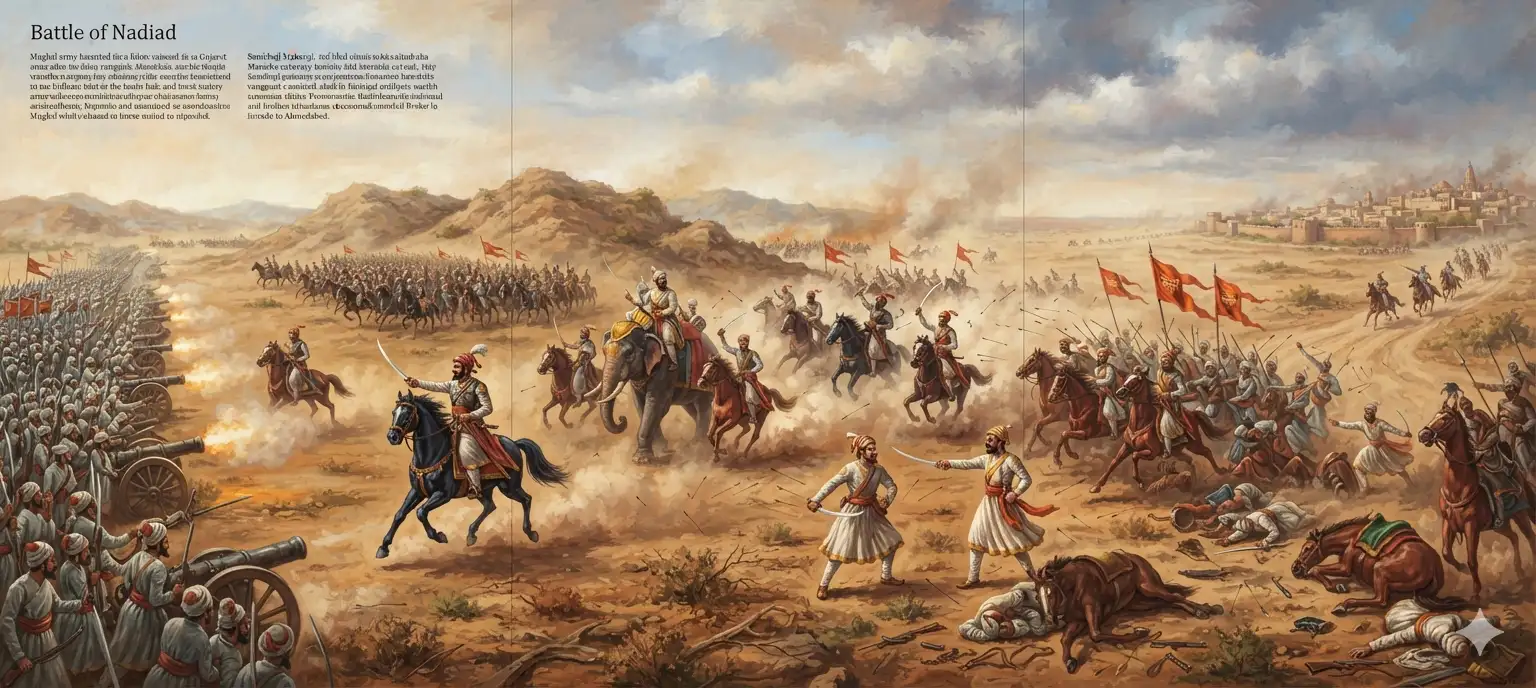
Sambhaji then committed his main reserve. The fresh Maratha troops crashed into the disorganized Mughal center while cavalry attacks continued on both wings. What had begun as an orderly advance quickly turned into a desperate struggle for survival. The battle raged for hours. Several Mughal commanders attempted to rally their men and restore the line, but repeated Maratha charges prevented them from reorganizing. As casualties mounted and formations began to collapse, large numbers of Mughal soldiers started retreating toward Ahmedabad. By late afternoon, the outcome was no longer in doubt. The Mughal army broke and fled from the field, abandoning artillery, baggage, and supplies. Maratha cavalry pursued the retreating forces for many miles, turning defeat into a rout. The Battle of Nadiad became one of Sambhaji Maharaj's greatest victories in Gujarat. Not only had he defeated the principal field army of the province, but he had also shattered the prestige of the Mughal administration. News of the victory spread rapidly across Gujarat, and many local chiefs who had previously hesitated now began to view Maratha supremacy as inevitable. With the road to Ahmedabad suddenly exposed and the Governor's army badly damaged, Sambhaji found himself in a stronger position than ever before. The battle marked a decisive turning point in the struggle for control of Gujarat.
Determined to exploit his victory at Nadiad, Sambhaji Maharaj wasted no time and marched north through Kheda toward Ahmedabad. The Mughal Governor, already shaken by the destruction of his main army, hastily assembled his remaining troops and attempted to block the Maratha advance outside the city. The resulting battle was brief. Demoralized by earlier defeats and heavily outnumbered, the Mughal forces were quickly overwhelmed by the advancing Marathas. As his army collapsed, the Governor attempted to flee toward the north, but Maratha cavalry pursued relentlessly and captured him before he could escape. With the governor in captivity and no significant force left to defend the province, resistance inside Ahmedabad quickly crumbled. The city gates were opened, and Sambhaji entered the provincial capital in triumph. The fall of Ahmedabad marked the end of organized Mughal authority in Gujarat and became the greatest Maratha success of the campaign. The capture of the provincial capital sent shockwaves across western India, and many cities and chiefs that had previously hesitated now accepted Maratha supremacy, recognizing the decisive shift in the balance of power.
The fall of Ahmedabad and the capture of the Governor of Gujarat convinced the Mughal court that continuing the war in the west would be costly and uncertain. At the same time, Bahadur Shah I had ascended the Mughal throne. Unlike Aurangzeb, the new emperor preferred reconciliation and stability over prolonged warfare. Envoys were exchanged between the Mughal court and Sambhaji Maharaj, and after lengthy negotiations, Bahadur Shah agreed to recognize Maratha control over Surat, Bharuch, Vadodara, Ahmedabad, and the territories between them. In return, Sambhaji agreed not to expand further into Gujarat and to maintain peace along the new frontier. During the negotiations, Sambhaji also secured the important trading city of Cambay (Khambhat), a concession the emperor accepted to preserve peace. The treaty formally ended the Gujarat campaign and marked the first official Mughal recognition of extensive Maratha possessions in the province. It secured some of western India's richest commercial centers for the Maratha state, while Bahadur Shah gained the stability he sought elsewhere in the empire. For Sambhaji, the agreement represented the culmination of years of military victories, diplomacy, and strategic maneuvering that transformed Maratha influence in Gujarat from occasional raids into recognized territorial control.
Following the Treaty of Ahmedabad, Sambhaji Maharaj turned his attention eastward toward the Mughal province of Berar. Believing the Mughals would be slow to recover from their recent setbacks in Gujarat, he resolved to carry the war into the Deccan once again. A large Maratha army of nearly 50,000 troops was assembled in Khandesh, and after completing his preparations, Sambhaji marched east into Berar to establish a foothold before the Mughals could organize an effective defense. His first objective was Akola, an important frontier town guarding the western approaches to the province. The Mughal garrison, caught off guard by the speed of the Maratha advance and lacking reinforcements, offered little resistance. Realizing that defending the town was impossible, the defenders abandoned their positions or surrendered. Sambhaji entered Akola without significant opposition and secured it as a base for further operations, opening the gates of Berar to the Marathas and marking the beginning of a new campaign against Mughal authority in the Deccan.
After securing Akola, Sambhaji Maharaj advanced deeper into Berar and marched on Balapur, the province's principal administrative center and the residence of the Mughal governor. Determined to halt the Maratha advance, the governor assembled his forces outside the city and offered battle. The engagement ended in a decisive Maratha victory, with Sambhaji's army overwhelming the Mughal troops, scattering the governor's field force, and capturing the city. However, realizing that further resistance in the open was hopeless, the governor withdrew with his remaining soldiers into the fortified stronghold of Balapur. While the city itself fell into Maratha hands, the fort remained under Mughal control. Protected by strong walls, ample supplies, and a determined garrison, the governor hoped to hold out until reinforcements arrived from neighboring Mughal territories. Sambhaji therefore faced the challenge of turning his battlefield success into complete control of Berar by reducing one of its strongest fortresses.
Confident that the garrison at Balapur was effectively contained, Sambhaji Maharaj left a portion of his army behind to continue the siege of the fort. Determined not to waste time in a prolonged wait, he took the remainder of his forces and pressed deeper into Berar. The rapid Maratha advance spread panic throughout the province. With the governor trapped inside Balapur and the main Mughal field army already destroyed, local officials found themselves isolated and without hope of immediate assistance. One after another, the important towns of Amravati, Ellichpur, and Washim fell before the advancing Marathas. Some offered only token resistance, while others surrendered outright upon learning of Sambhaji's approach. Within a short period, nearly all of Berar outside the walls of Balapur acknowledged Maratha authority. Revenue offices, military stores, and administrative centers passed into Sambhaji's hands, further strengthening his position.
The Mughal governor remained confined to his fort, increasingly aware that while he still possessed Balapur, the rest of the province was rapidly slipping beyond his control. By the end of the campaign season, Balapur stood as the last major Mughal stronghold in Berar, surrounded on all sides by territory now controlled by the Marathas.
As the months passed, Sambhaji Maharaj tightened the siege around Balapur Fort. Maratha forces cut off all supply routes, intercepted messengers, and prevented any meaningful relief from reaching the besieged garrison. With the rest of Berar already under Maratha control, the governor found himself increasingly isolated within the fortress. Food supplies gradually reduced, morale declined, and hopes of rescue faded. Realizing that further resistance would only bring unnecessary suffering to his remaining soldiers, the governor opened negotiations with Sambhaji. After discussions, he agreed to surrender Balapur and formally relinquish Mughal authority over Berar. Demonstrating both generosity and political wisdom, Sambhaji spared the governor and granted him a pension supported by the revenues of a few villages. In return, the fort was peacefully handed over to the Marathas and the remaining garrison laid down its arms.
With the surrender of Balapur, the conquest of Berar was complete. Sambhaji took control of the entire province, including Akola, Amravati, Ellichpur, Washim, and Balapur. Maratha administrators and military commanders were appointed throughout the region to establish permanent rule and integrate Berar into the expanding Maratha state. The annexation of Berar marked another major achievement for Sambhaji. What had begun as a campaign against a frontier province ended with the complete transfer of one of the Mughal Empire's most important Deccan territories into Maratha hands, further extending Maratha influence across central India.
Having secured Berar, Sambhaji Maharaj turned his attention toward the rich Mughal province of Hyderabad-Golconda. A large Maratha army was assembled at Balapur, and after completing his preparations, Sambhaji marched eastward into Telangana. The Maratha advance was rapid. Sambhaji first occupied the region around Deglur before moving on to Nizamabad. Mughal outposts in the area offered little resistance, and within a short time the district fell under Maratha control. News of the advancing army quickly spread throughout the province, causing alarm among Mughal officials. When reports of Sambhaji's progress reached Hyderabad, the Mughal governor immediately recognized the danger. He ordered the commander of Golconda Fort to prepare for a prolonged siege by stockpiling grain, water, ammunition, and other essential supplies. Defensive works were strengthened, additional troops were stationed on the walls, and every effort was made to ensure that the fortress could withstand a lengthy blockade.
At the same time, the governor dispatched a large field army from Hyderabad with orders to reinforce and protect Golconda. His intention was clear: the Marathas were to be stopped before they could surround the fortress, for if Golconda were lost, Mughal authority throughout the province would be placed in grave danger. As Sambhaji continued his advance from Nizamabad toward the heart of the province, the Mughal relief army marched out from Hyderabad to meet him.
After securing Nizamabad, Sambhaji Maharaj continued his advance through the Kamareddy region and reached Medak. With the Maratha army steadily approaching the heart of the province, he sought to achieve through diplomacy what might otherwise require a costly siege. From Medak, Sambhaji dispatched envoys to the commander of Golconda Fort. The message offered generous terms. If the commander surrendered the fortress peacefully and acknowledged Maratha supremacy, he would be permitted to retain his position and continue administering the city under Maratha protection. However, the proposal was accompanied by a stern warning: should the offer be rejected, Golconda would face siege and the devastation that inevitably followed prolonged resistance. The message was received within the walls of the great fortress. Yet the commander of Golconda remained confident. The fort's massive granite defenses, powerful artillery, abundant supplies, and newly reinforced garrison convinced him that the Marathas would be unable to take the stronghold easily. Moreover, he knew that a Mughal field army had already been dispatched from Hyderabad to support the defense of the province.
Trusting in the strength of Golconda's walls and cannons, the commander rejected Sambhaji's proposal and declared his intention to defend the fortress in the name of the Mughal Empire. The envoys returned to Medak with the answer. Sambhaji now understood that Golconda would not be won through negotiation. The fate of the province would instead be decided by arms, as the Maratha army prepared to advance and the Mughal relief force marched out from Hyderabad to challenge it.
Leaving Medak behind, Sambhaji Maharaj resumed his advance toward Golconda. The Maratha army moved steadily southward, occupying villages and outposts along the way. Expecting that the Mughal commanders would withdraw behind the mighty walls of Golconda Fort, Sambhaji focused his preparations on an upcoming siege rather than a major field battle. Within days, the Marathas reached the outskirts of Golconda. The massive granite fortress loomed above the surrounding countryside, its walls lined with artillery and its banners visible from miles away. Maratha commanders began surveying the ground and selecting positions for siege camps, believing that their next challenge would be reducing the fortress itself. However, the defenders had other plans. Unknown to the Marathas, the Hyderabad governor had dispatched a field army that had taken a concealed route through the countryside east of Golconda. While Sambhaji's attention remained fixed on the fortress, the Mughal force from Hyderabad maneuvered into position. At dawn, just as Maratha troops were establishing their camps, the Mughal army suddenly emerged and struck one of the Maratha wings.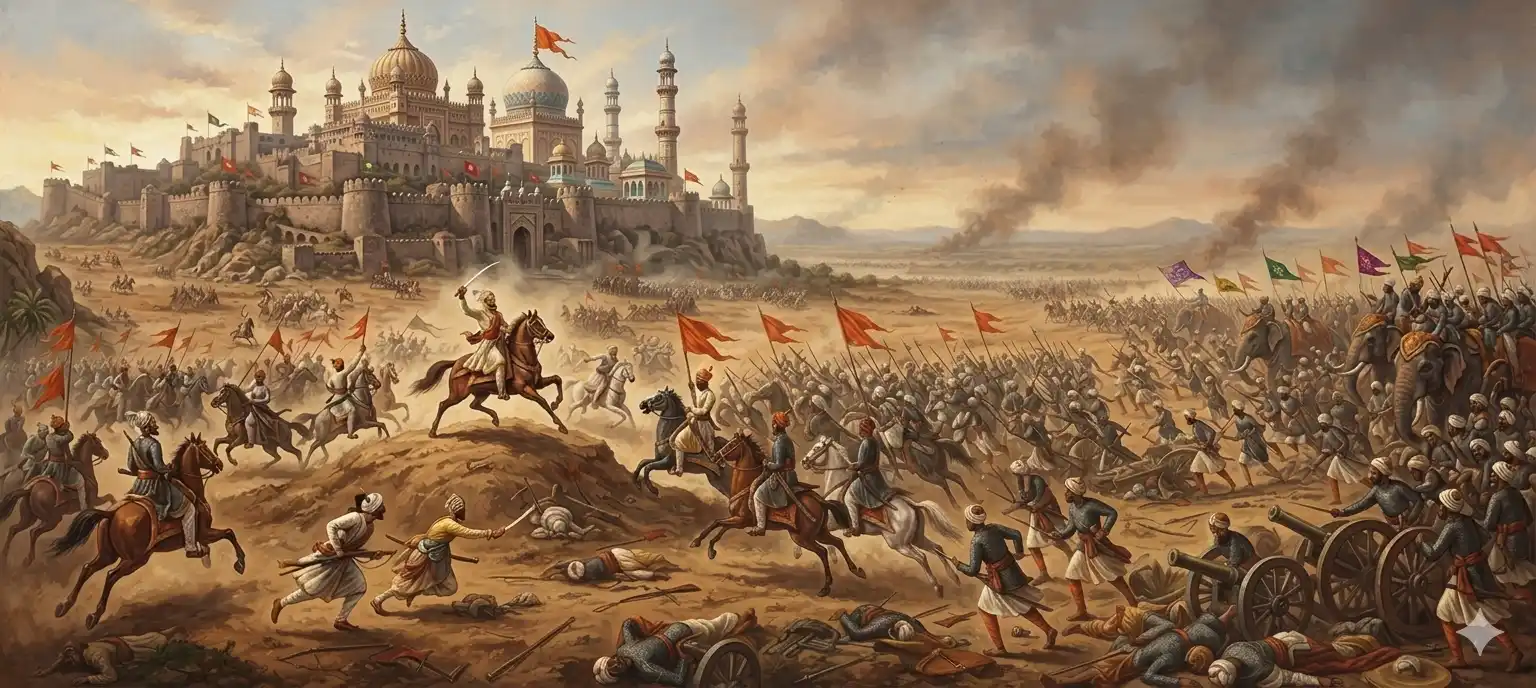
The attack achieved complete surprise. For a brief period confusion spread through the Maratha camp as soldiers rushed to form ranks and officers struggled to understand the scale of the threat. The Hyderabad commander hoped to exploit this disorder and drive the Marathas away before they could organize a siege. Sambhaji, however, reacted swiftly. Rather than committing his entire army immediately, he ordered nearby units to hold the line and absorb the initial assault while messengers raced across the battlefield carrying new instructions. Veteran cavalry formations were redirected toward the threatened sector, and reserve troops were rapidly brought forward. As the Hyderabad army pressed its advantage, believing the Marathas were beginning to break, Sambhaji executed a sudden counterstroke. Fresh cavalry swept around both flanks of the attacking force while infantry stabilized the center. The Hyderabad troops, who had advanced aggressively during the opening stages of the battle, gradually found themselves overextended and separated from their supporting formations.
The fighting intensified throughout the day. What had begun as a surprise attack slowly turned against its authors. Maratha horsemen repeatedly struck the enemy's flanks and rear, disrupting communications and creating confusion among the Hyderabad ranks. Attempts to restore order were met by renewed Maratha charges. By afternoon the momentum had shifted completely. The Hyderabad army's line began to fracture under constant pressure. Once gaps appeared, Sambhaji committed his final reserves, launching a general advance across the battlefield. The exhausted defenders could no longer maintain cohesion. Units started retreating toward Hyderabad, and the retreat soon turned into a rout. Maratha cavalry pursued the fleeing army for many miles, capturing supplies, artillery, and numerous officers. The remnants of the Hyderabad force eventually escaped, but they were no longer capable of challenging Sambhaji in the open field. The battle proved decisive. The one army sent to relieve Golconda had been shattered. More importantly, the victory left the fortress isolated. With no substantial field force remaining between him and his objective, Sambhaji returned to the outskirts of Golconda and began preparations for the great siege that would determine the fate of the province.
With the Hyderabad field army destroyed, Sambhaji Maharaj turned his attention toward Golconda, the last great stronghold standing against him in the Deccan. The fortress was considered nearly impregnable, protected by massive granite walls, powerful artillery, and a determined garrison. A direct assault would come at a heavy cost, and Sambhaji knew that victory would require more than force—it would require strategy.
As the Maratha army surrounded the fortress, Sambhaji Maharaj looked beyond its walls and studied the divisions within its command. He learned that the governor of Golconda had become deeply estranged from his own brother, creating a dangerous rift among those responsible for defending the fort.
Seeing an opportunity, Sambhaji Maharaj opened negotiations with the governor’s brother. He promised the governor’s brother a powerful reward: the governorship of both Golconda and the recently conquered province of Berar once the campaign was complete. In return, he asked for access to a secret passage into the fortress—a hidden route known only to few trusted people. The offer was difficult to ignore. After weighing the risks and rewards, the governor’s brother agreed to reveal the passage.
On a moonless night, selected Maratha troops entered through the hidden passage and gained access to the interior of Golconda. But the element of surprise did not guarantee an easy victory. Once the alarm spread, the defenders rushed to confront the attackers. The narrow passages and courtyards of the fortress became the scene of fierce close-quarters fighting.
The fort’s cannons thundered as the defenders attempted to drive back the invading force. Explosions shook the walls, and fragments of shattered stone and iron tore through the chaos of battle. Yet the Maratha troops continued to push forward, opening the way for more soldiers to enter and gradually seize control of key positions within the fortress.
After intense fighting, Golconda finally fell to Sambhaji Maharaj. The saffron banner rose above the ancient walls, marking another major triumph in the Maratha expansion across the Deccan—a victory achieved through a combination of military strength, political understanding, and daring strategy.
Yet triumph came at a terrible price. During the final stages of the siege, Sambhaji was struck by fragments from a cannon shot fired from the fortress while personally directing operations near the walls. Though he remained on horseback and concealed the severity of his wounds from his men, his condition worsened rapidly after the victory. Determined to witness the completion of the conquest, he insisted on entering Golconda and personally overseeing the raising of the Maratha flag above the fortress. Only after the banner flew over the citadel did he allow himself to be carried to his quarters. For several days he struggled against his injuries as news of his condition spread throughout the camp, casting a shadow over the greatest victory of his reign. Despite the efforts of physicians and attendants, the wounds proved too severe. A few days after the fall of Golconda, Sambhaji Maharaj passed away. His death plunged the camp into mourning. Veterans who had followed him through countless campaigns wept openly, while commanders and soldiers alike paid tribute to the ruler who had transformed a kingdom fighting for survival into a vast empire. The Maratha banner still flew proudly above Golconda, but the man who had carried it there was gone. Thus ended the life of Sambhaji Maharaj—victorious in his final campaign, master of an empire stretching across much of western and central India, and remembered by his followers as the conqueror who had carried Maratha power farther than ever before.
The death of Sambhaji Maharaj at Golconda shocked the Maratha Empire, but unlike many feared, it did not send the state into civil war. Years of successful campaigns had left the empire wealthy, secure, and respected by both allies and enemies. The senior Maratha commanders therefore moved quickly to ensure an orderly transfer of power. In the years that followed, Shahu emerged as the accepted ruler of the Maratha Empire. Because Sambhaji had died at the height of Maratha strength and left behind a stable state, the succession disputes that had historically divided the Marathas never developed into a major conflict. No prolonged struggle arose between the supporters of Shahu and those of Tarabai. The leading sardars, recognizing the dangers of internal division, united behind a single throne and preserved the unity of the empire.
The newly conquered territories of Gujarat, Berar, Nanded, and Golconda remained under Maratha control. Governors appointed during Sambhaji's reign retained their positions and continued administering these provinces in the name of the new ruler. Although occasional revolts and local disturbances occurred, none were serious enough to threaten Maratha authority. The Mughal Empire reacted to Sambhaji's death with relief, but also with disappointment. The emperor had lost his most formidable opponent, yet the vast empire created by him remained intact. The resources required to recover Gujarat, Berar, and Golconda were simply unavailable to a Mughal state already weakened by decades of war. Consequently, the frontier between the two powers stabilized, and diplomacy gradually replaced large-scale campaigns.
Under Shahu, the Maratha Empire continued to develop along lines familiar to later history. The administrative institutions, military traditions, and political networks established during the reigns of Shivaji and Sambhaji endured. While future generations would face new opportunities and challenges, they did so from a position of strength created by Sambhaji's extraordinary conquests. Thus, while the later history of the Marathas broadly followed a familiar course, it began from a far stronger foundation. Instead of inheriting a kingdom struggling to recover from years of crisis, Shahu inherited a vast and prosperous empire stretching from Gujarat to Golconda, secured by the victories of his predecessor and united under a single crown.
Historians would later agree that the single most important moment in this alternate history occurred not at Ahmedabad, Berar, or Golconda, but at Sangameshwar. Had Sambhaji Maharaj fallen into Mughal hands there, the history of the Indian subcontinent would have unfolded very differently. Instead, his escape altered the destiny of the Maratha state and changed the balance of power across India. The immediate consequence was the survival of Maratha leadership at a moment of great danger. Rather than descending into years of desperate struggle, the Marathas remained united under an experienced ruler who was able to direct the war against the Mughal Empire. What followed was a remarkable series of victories that transformed the Marathas from a regional kingdom into a vast imperial power.
The Mughal Empire suffered the greatest consequences from Sambhaji's survival. Decades of effort and enormous resources invested in the Deccan failed to produce the decisive victory that Aurangzeb had sought. Instead of crushing the Marathas, the empire found itself steadily retreating from Maharashtra and eventually losing influence over Gujarat, Berar, and Golconda. By the time of Bahadur Shah's reign, the Mughal court had abandoned hopes of restoring its former dominance in the Deccan and increasingly focused on preserving stability in northern India. Within the Maratha Empire, the effects were equally profound. The long and successful reign of Sambhaji created strong institutions, experienced administrators, and loyal commanders throughout the newly conquered territories. As a result, the succession following his death occurred peacefully, with Shahu ascending the throne without major civil conflicts that could divide the empire.
The unity of the Maratha state allowed future generations to build upon Sambhaji's achievements rather than struggle to recover from internal disputes. Economically, the empire entered a period of unprecedented prosperity. Control over Gujarat brought access to some of India's richest commercial centers, while the conquest of Berar and Golconda connected the Marathas to major agricultural and trading regions of the Deccan. Trade routes stretching from the Arabian Sea to the interior flourished under Maratha protection, strengthening the treasury and the foundations of the state. Culturally, Sambhaji's reputation underwent a transformation. Instead of being remembered primarily as a tragic martyr who died resisting Mughal power, he came to be celebrated as one of the greatest builders of the Maratha Empire. Chronicles, and folk traditions remembered him as the ruler who carried the saffron banner from the Sahyadris to Ahmedabad and Golconda.
The survival of Sambhaji also changed the psychological landscape of India. The belief that the Mughal Empire was invincible faded much earlier than in actual history. Regional rulers increasingly viewed the Marathas as the rising power of the subcontinent, while Mughal authority became something that could be challenged, negotiated with, and defeated. Yet despite all his victories, Sambhaji did not live to enjoy the full fruits of his success. Fate denied him the opportunity to rule over the empire he had created. His final triumph at Golconda became both the culmination of his life's work and the closing chapter of his reign. The image that endured through the centuries was that of a wounded king watching the Maratha flag rise above Golconda Fort, knowing that the struggle was won even as his own life drew to an end.
Thus, the history of India was changed not by a single battle or conquest, but by a single escape. At Sangameshwar, one man survived, and from that moment began the survival of the Maratha state, the rise of a vast empire across western and central India, the peaceful succession of Shahu, and the reshaping of the political order of the subcontinent. In the end, Sambhaji's greatest victory was not the capture of any city or fortress, but the creation of an empire strong enough to endure beyond him. His enemies could challenge his armies, besiege his forts, and contest his conquests, but they could not erase the legacy born from that fateful escape at Sangameshwar—a moment that changed the course of history.